Last year I wrote about a Favre-Leuba Deep Blue diver, which reminded me about this Twin Matic model I’ve had in my project box for quite some time.
(Click pictures to enlarge)
Before I get into the specifics of this watch, I mentioned in the last Favre-Leuba post that the company set up a base in India, in 1865. What I didn’t realise at the time of writing was just how significant that was for Favre-Leuba.
By the beginning of the 20th century, Favre-Leuba were firmly established in the region and moved their headquarters to Bombay in 1913, subsequently managing their entire operation from British India.

All of Favre-Leuba’s wristwatches produced before 1940 had used ébauche calibres (a.k.a. calibres made by other manufacturers), but by the mid-1940’s the acquisition of two companies, Acacia and Bovet Frères SA, gave Favre-Leuba their own manufacturing facilities in Switzerland.
This led to the development of their first in-house calibre, the FL cal. 101 in 1955, with automatic versions following soon after (the FL cal. 103 & 104).
Development continued apace and in 1962, a new in-house calibre, the “Twin Power” FL cal. 251 was released, a 17 jewel, manually wound calibre featuring two mainspring barrels running in parallel, giving an increased power reserve of 50 hrs.
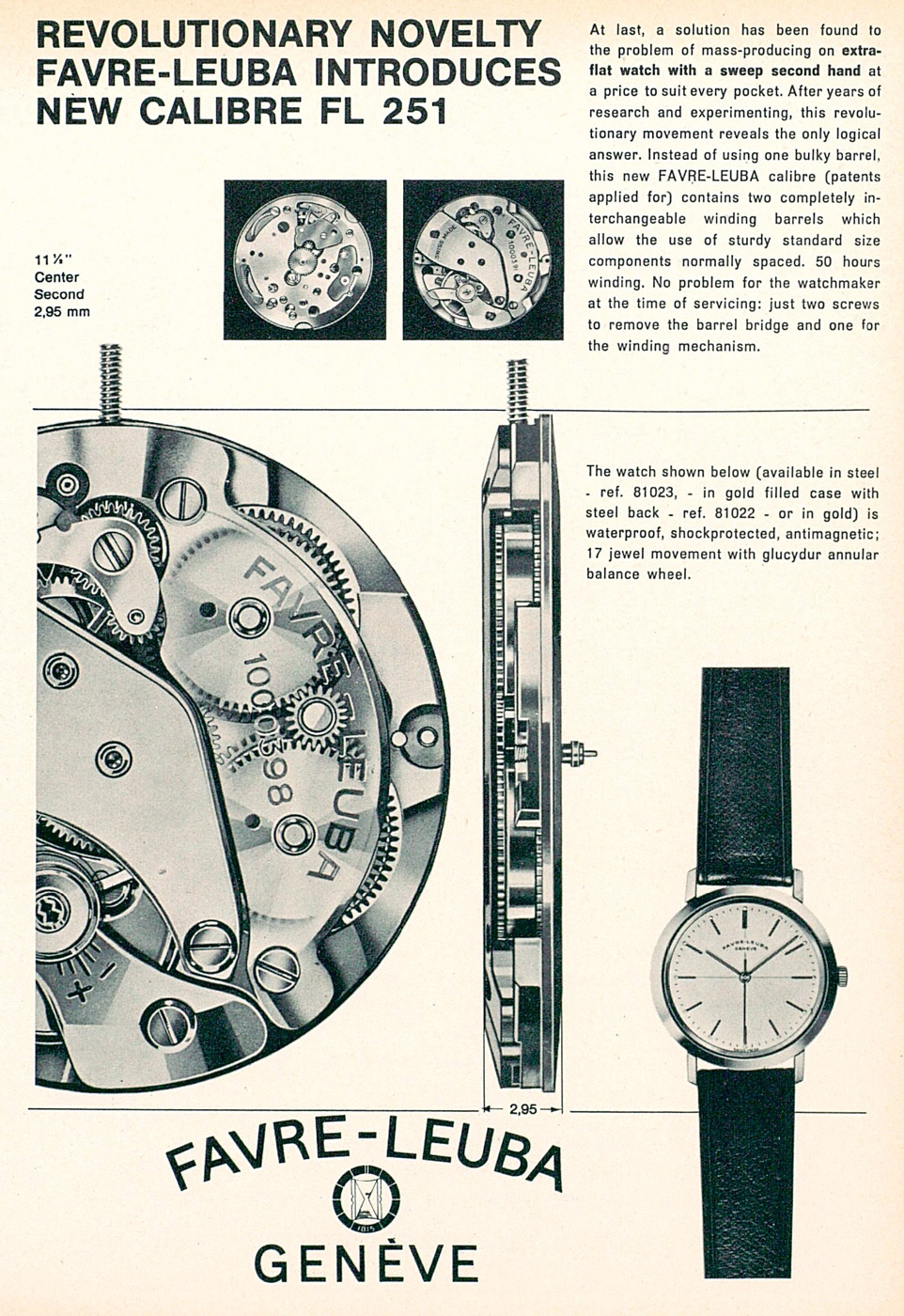
Subsequent versions followed with technical improvements and the addition of a date, the range topper being the FL cal. 259 – I’ve written previously about a Twin Power watch on the blog, that post here.
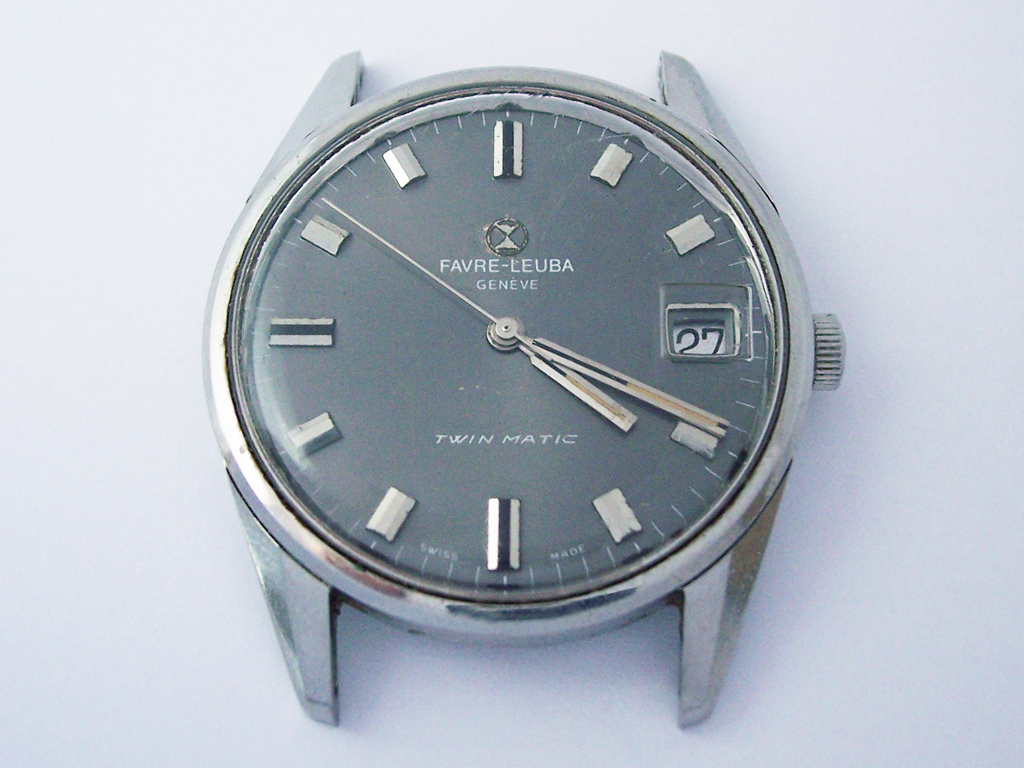
All that build-up brings me nicely on to the subject of this post, the “Twin Matic”, the automatic version of the manually wound, Twin Power calibre.
Opening up the watch, inside is a FL cal. 269; a 25 jewel, 18,000 bph, automatic calibre featuring a date and the aforementioned dual mainspring barrels.
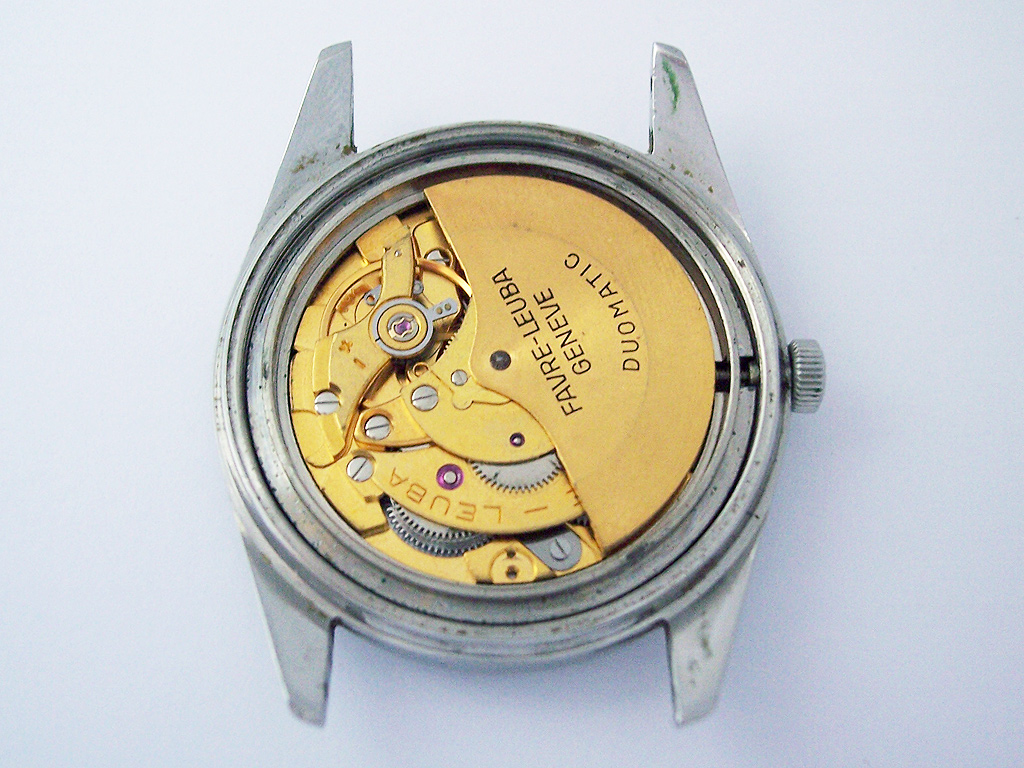
First released in 1968, the calibre is notable as it is only 4.05 mm high, just 0.95mm taller than the manually wound FL cal. 259 on which it is based. (There were also non-date versions, the FL cal. 263 and FL cal. 253 at heights of just 3.95 and 3.00mm respectively).
These diminutive dimensions resulted in thin watches that slipped easily under a shirt cuff, the difference between the manual and automatic being indistinguishable on the wrist.
Before getting into the technical details of the calibre, it’s worth taking a stroll down tangent boulevard to mention Favre-Leuba’s naming conventions for their automatic models, which are, frankly, a mess!
As well as the Twin Matic seen here, you can also find watches with “Automatic”, “Day-Matic” and “Duo-Matic” on the dial.
Logically, you would think that “Duo-Matic” also denotes that the watch has a twin barrel calibre, right? Nope.
Confusingly, you will see the Duo-Matic name on the dial of watches powered by Favre-Leuba’s other line of automatic calibres, the FL cal. 11xx, which were all based on the A. Schild cal. 1687/88, co-developed by Doxa, Eberhard, Favre-Leuba, Girard-Perregaux, and Zodiac in the early 1960’s.
To add further to the confusion, the Twin Matic FL cal. 269, was labelled “Duo Matic” on the winding rotor, but can also be found with matching “Twin Matic” branding too.
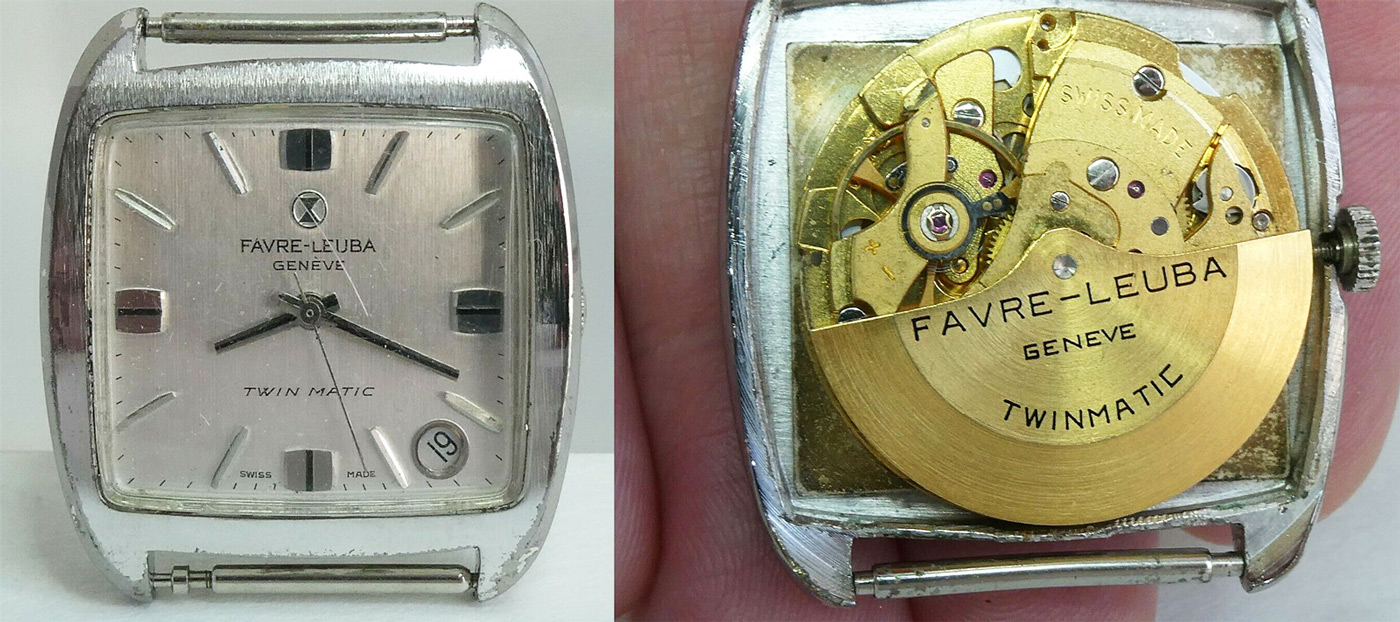
Confused yet? Yep, me too. As I said, a mess…. buying a Favre-Leuba automatic from this period without seeing the movement can be a lottery!
Judging by how few of these Twin Matics there are around, I suspect it was a short production run. As there is very little information currently online about the FL 269 calibre, I’ll cover the main technical differences in the automatic calibre in case it’s of use or interest to anyone.
The winding rotor is mounted on its own bridge, which when removed, reveals a small intermediate gear which oscillates back and forth, kept in place by a thin spring on the click lever. The auto-winding function is uni-directional on this calibre (it only charges the mainsprings when the rotor spins clockwise).
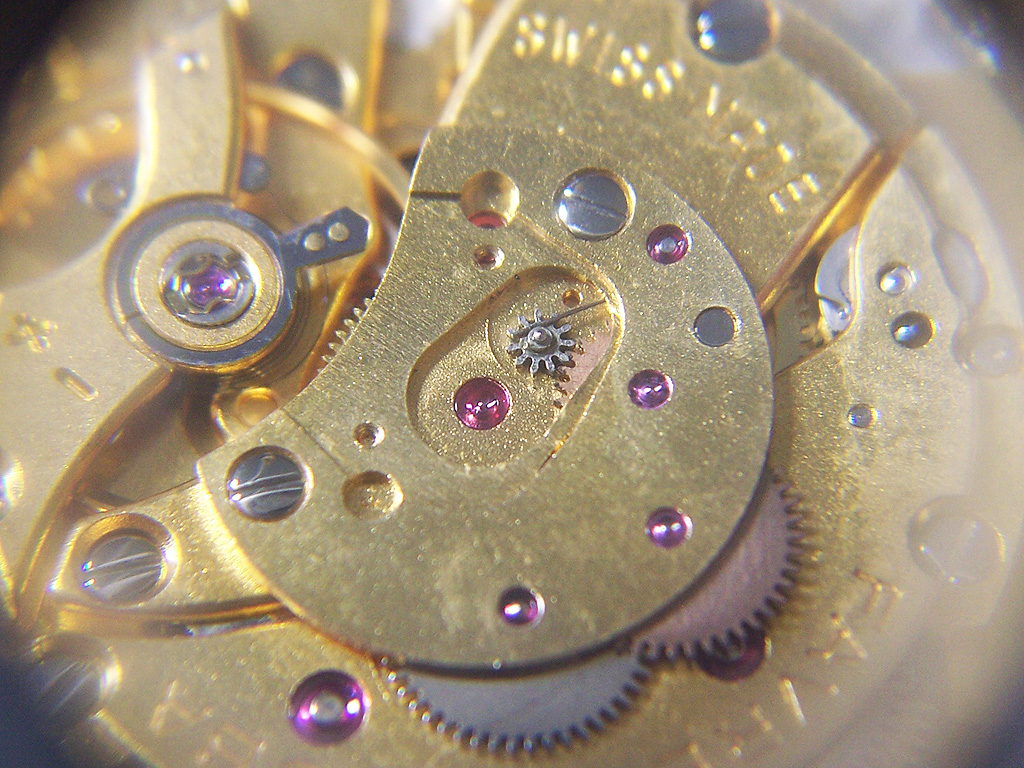
Removing the automatic winding bridge, reveals a series of intermediate wheels feeding power from the rotor to the twin mainspring barrels simultaneously.
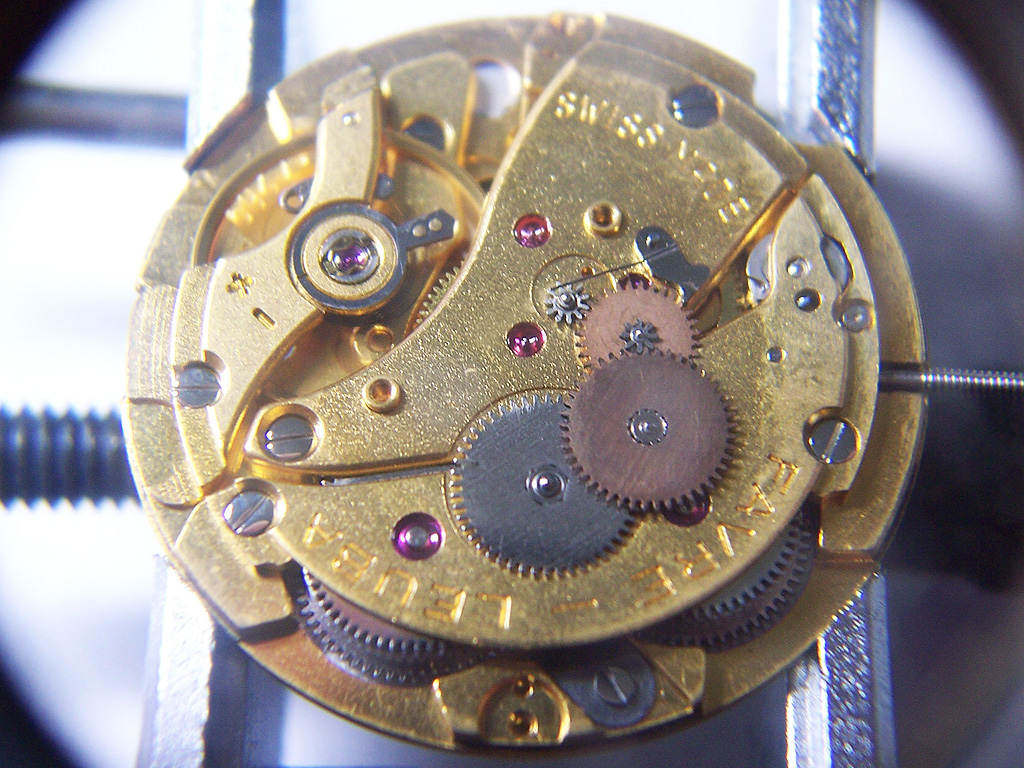
The last wheel in the train is comprised of three distinct parts, a central wheel with a square barrel section and two parts forming a sliding clutch mechanism.
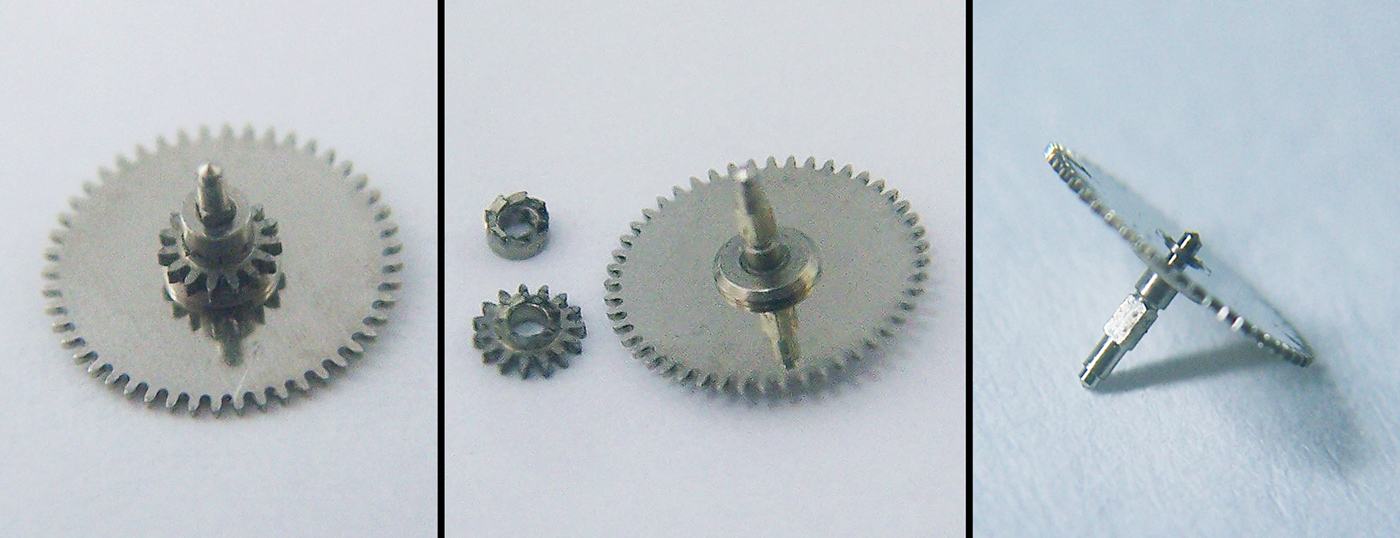
As this calibre can also be manually wound, this clutch mechanism is used to disengage the two ratchet wheels on the mainspring barrels from the automatic mechanism when winding manually.
Tension for the clutch mechanism is provided by a spring mounted on the mainplate which provides upward pressure, forcing the two parts together.
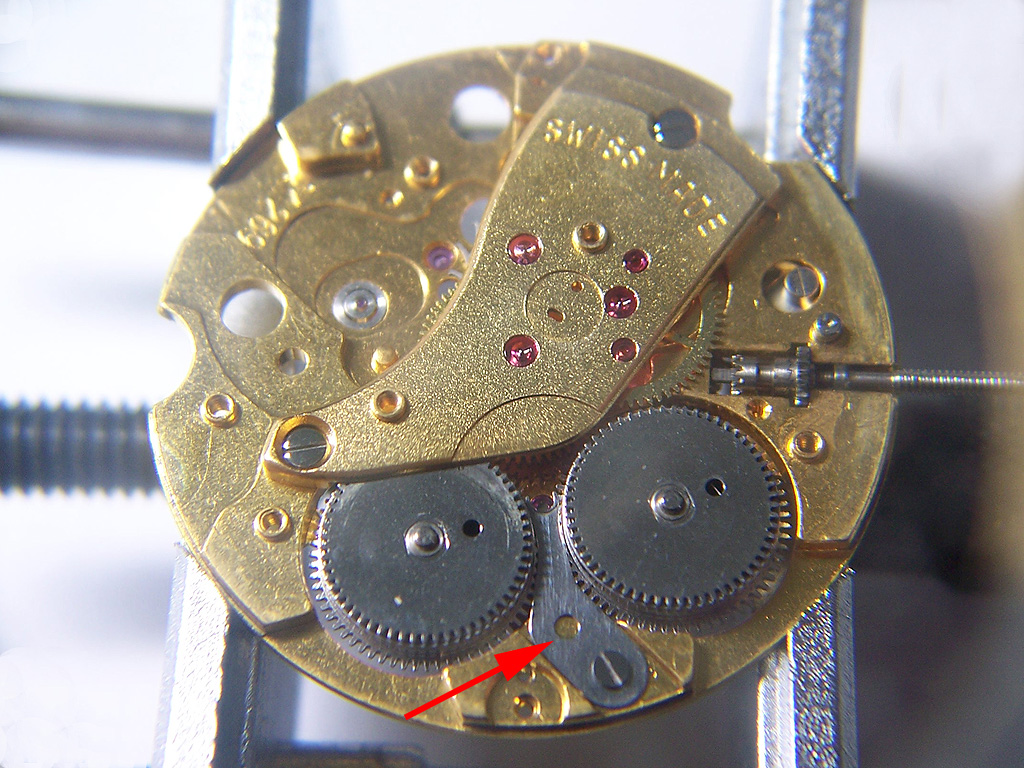
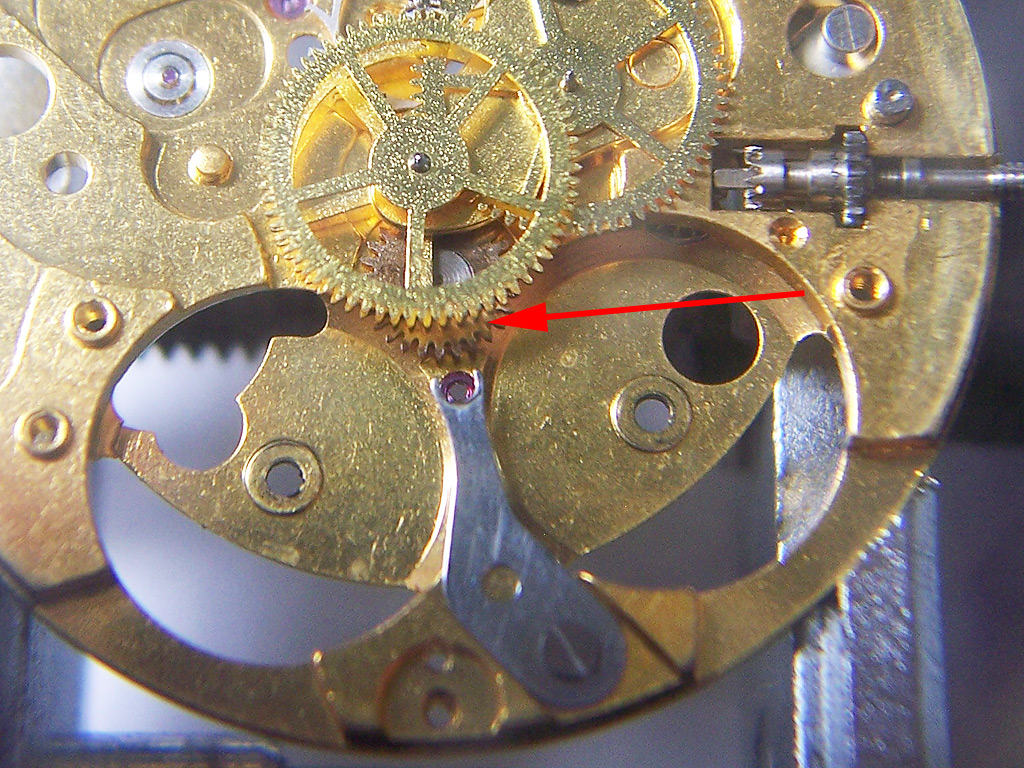
Like the equivalent manually wound calibre, power is provided to the centre wheel from both mainspring barrels simultaneously via an intermediate wheel on the mainplate, balancing the power delivery and resulting in a more stable rate.
Being an automatic, the barrels contain mainsprings with bridles which slip around the inner walls when fully wound. Like the manually wound calibre, the mainsprings are much thinner than a conventional mainspring, each providing 50% of the required power to the wheel train.
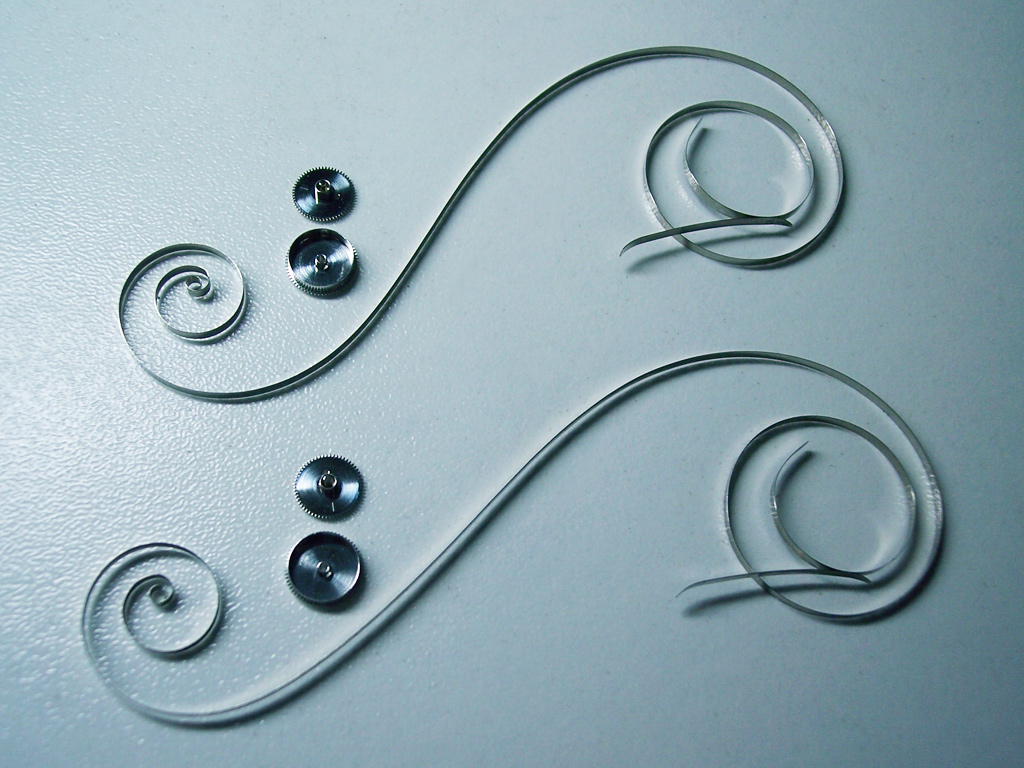
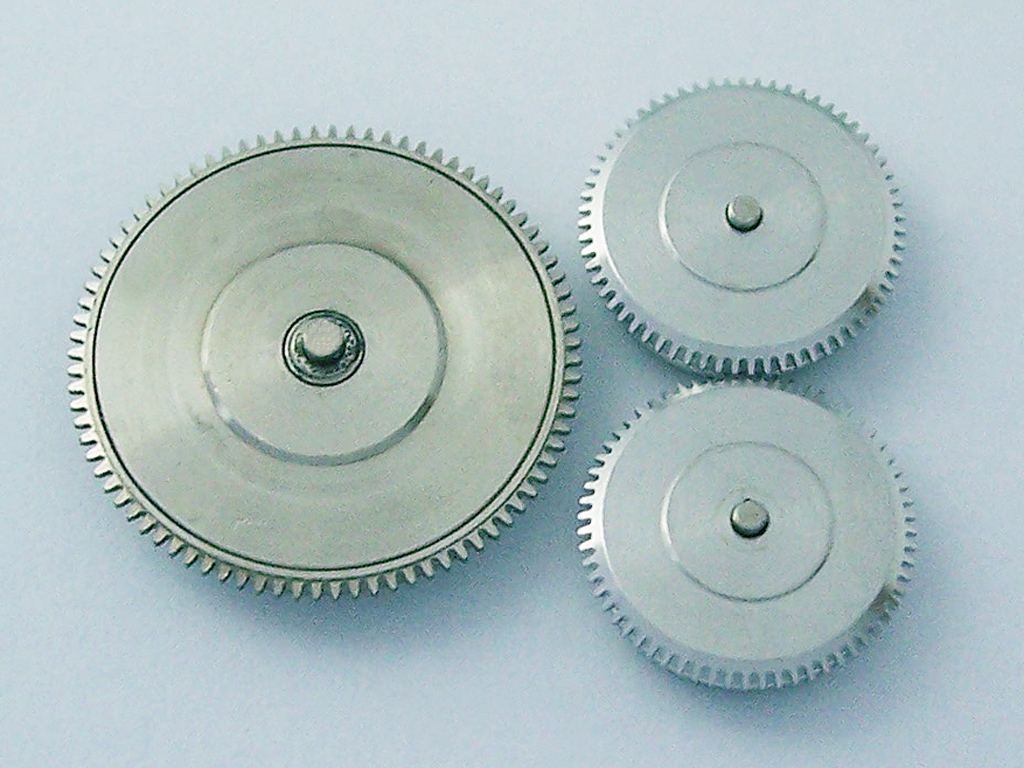
The barrels are also tiny, compared to a conventional mainspring barrel, here they are next to a barrel from a Seiko cal. 6119C for comparison.
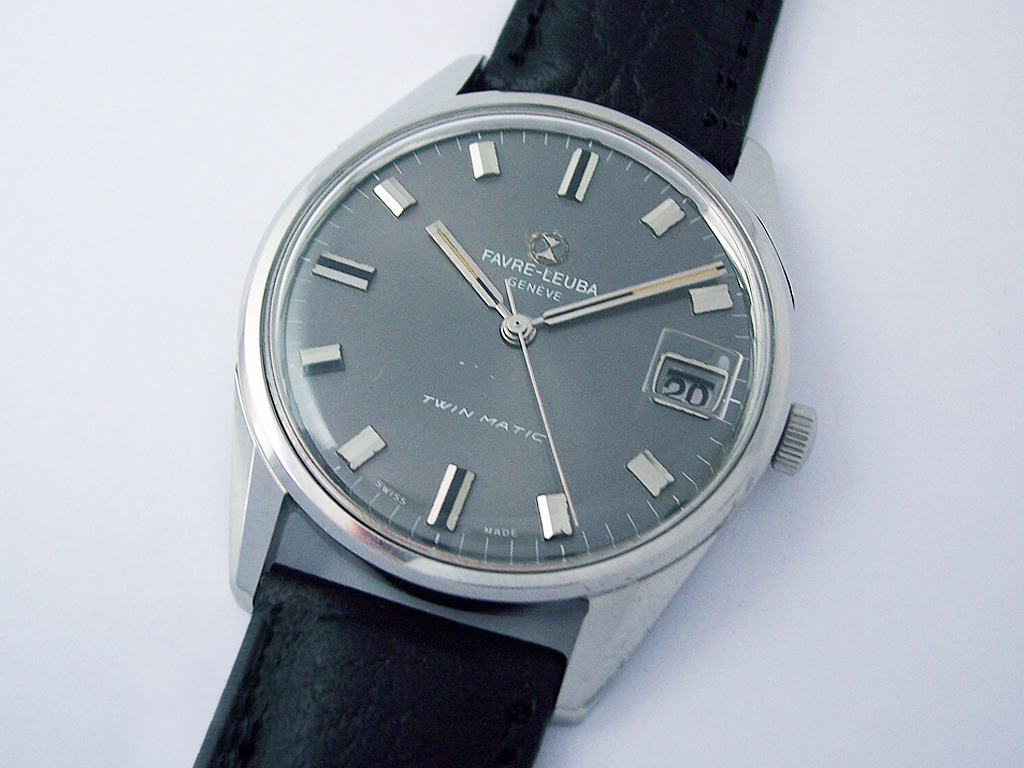
Although the watch wasn’t running on arrival, it just needed a routine service to bring it back to life. The case was cleaned, the crystal polished and a new caseback gasket fitted to finish the job.
The Favre-Leuba logo on the dial has tarnished a little and there are a few minor blemishes on the dial, but overall it’s pretty good. It still has its original branded crown and crystal with date magnifier too, which is a bonus.
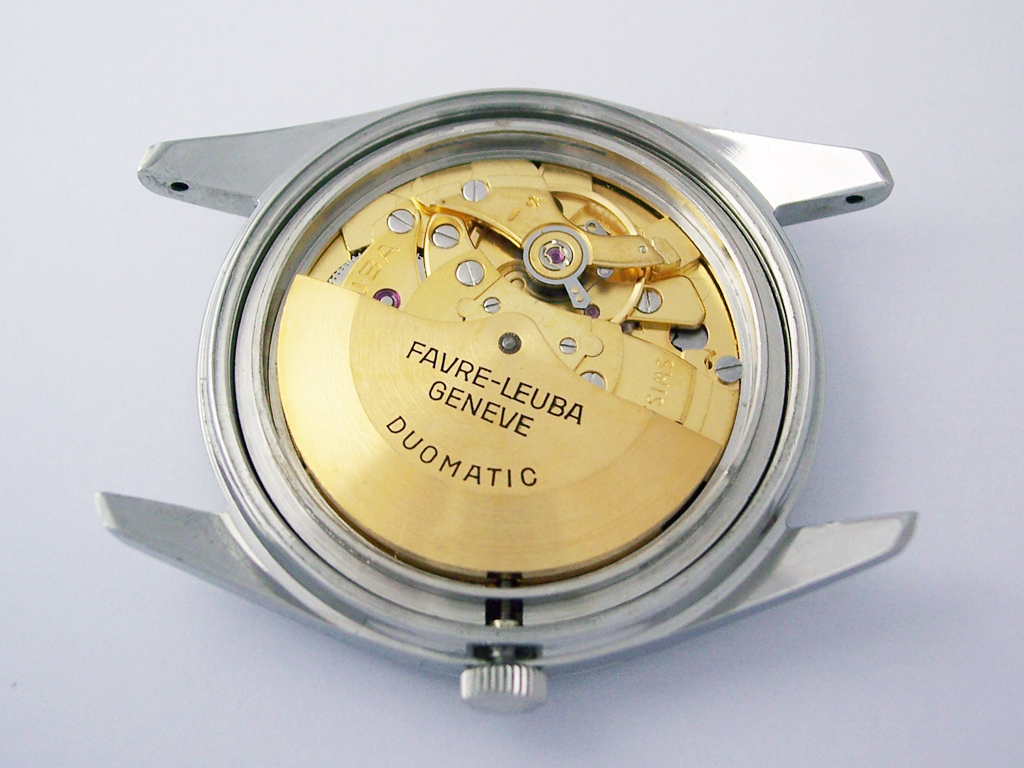
It’s worth mentioning again that care should be taken when buying any vintage Favre-Leuba watch these days. Favre-Leuba maintained strong ties with India throughout the 1960’s and 70’s, exporting their watches directly into the Indian market.
As a consequence, in recent years the market has been flooded with Indian Favre-Leuba watches with refinished dials, often in lurid colours, which has had a detrimental effect on the reputation of the brand.
Given the high humidity in that region, the movements and cases are often in extremely poor condition, all of which is hidden behind a pretty looking dial and polished case…. approach with caution would be my advice!
Rich.