Wristwatch restoration, servicing and repair

Archive for the ‘Alarm Watches’ Category

Seiko 4005-7000 (27J Bell-Matic)…

I’ve written quite a few posts about Bell-Matics and their calibres, but it’s been well over a year since one appeared on the blog. This one however is somewhat rare, and in some respects is the missing chapter of the story.

(Click pictures to enlarge)

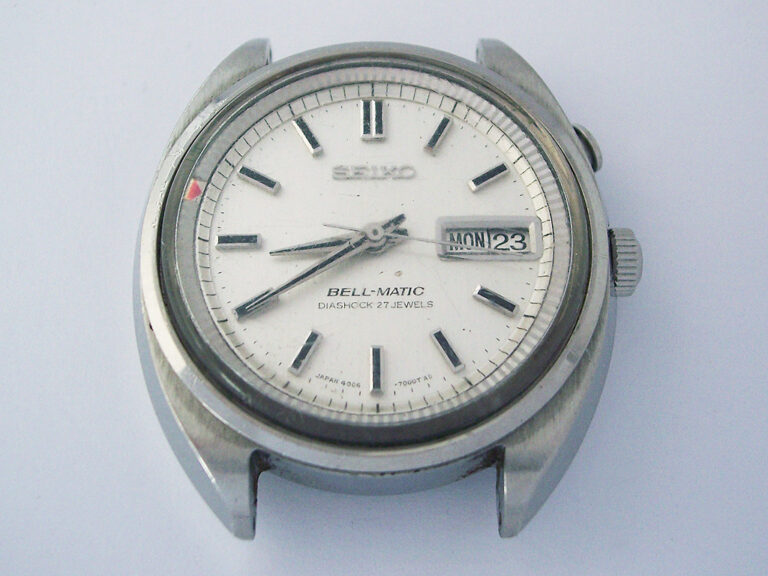
What makes this Bell-Matic stand out from the crowd is that it has a date only calibre, the cal. 4005A, rather than the day/date cal. 4006A found in the majority of Bell-Matics.

The date only models were produced in the early days of the production cycle, and only for a couple of years before being phased out.  Only two models were available, the subject of this post (also available with a blue dial) and this one, available with either a black or white dial.

The cal. 4005A was only available in a 27 jewel version and like all Bell-Matic calibres, the jewel count is clearly displayed on the winding rotor, and the calibre number on the winding bridge.

The main difference between this calibre and the 4006A is of course the calendar mechanism. With the dial removed, comparing the two calibres you can see that the advancing wheel and day jumper found in the 4006A are missing from the calendar plate on the 4005A.

In terms of other differences, the unlocking wheel has no raised boss for the day disc, and the date ring is not as deeply recessed as no additional space is needed to accommodate the day wheel.

Other than that the calibres are identical from a technical perspective, but there are subtle differences in the case designs for the two model lines. The date only models use a different crystal for example.

Although running on arrival, this Bell-Matic had ‘lost it’s voice’. The alarm wouldn’t wind up any more, which all pointed to either a problem with the crown wheel or a broken alarm mainspring.

Sure enough, the problem turned out to be broken alarm mainspring, so with that replaced and the rest of the movement serviced, it was back up and running again.

Rich.

** Many thanks to Neil Lever for letting me feature his watch on the blog. **


Seiko 4006-6011 (17J Bell-Matic)…

I was very surprised to be the only bidder on this, one of the more popular 17 jewel Bell-Matics…

(Click pictures to enlarge)

The watch didn’t run, needed a new crystal and was missing it’s stem and crown, but I think it must have slipped under the radar of my usual Bell-Matic competitors, so I was delighted to snap it up for a very reasonable opening price.

On arrival I was even more pleased as the dial and hands were near perfect, the case had no corrosion at all, and the movement was spotless… it even had a casing spring! The only down side was that one of the dial feet had been snapped off.

I’ve had quite a few Bell-Matics with broken dial feet now which is odd, as I rarely see it on other watches. The only thing I can think of that would cause it would be a very heavy knock, but then I’d expect to see other damage too, broken pivots or balance staff for example. Whatever the reason, with a dial in this condition it was certainly worth the extra effort involved in fixing it…

I’ve given up trying to figure out which Bell-Matic dials have a built in spacers as there seems to be no pattern to it at all, but luckily this dial was one of them so drilling out the old dial foot and making a new one was pretty straight forward. (I’ve posted about fixing dial feet before, click here if you missed it.)

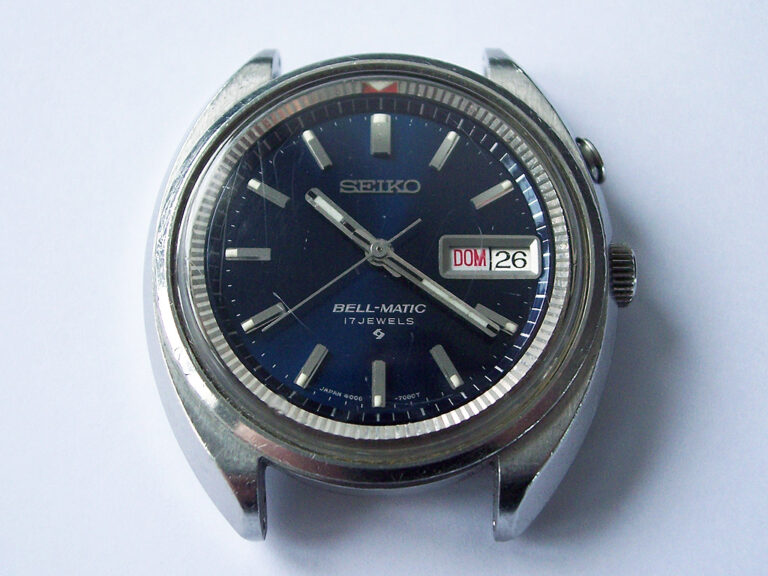
With the dial repaired, I found a suitable crown and stem in the parts box, then a clean and oil for the movement and a new crystal finished the job. There’s no doubt about it, Seiko make a great blue dial, everyone should have one…

Rich.


Sekonda Alarm…

I’m always on the lookout for different alarm watches so this Sekonda caught my eye…

As is common in many alarm watches, the watch has two separate crowns, the upper crown controls the winding of the alarm spring and setting the trigger time and the lower crown works just like a regular manually wound watch, winding the mainspring and setting the time.

The calibre in this watch is a Russian Poljot Cal. 2612.1 and working on this one provided insight into two calibres at once as the 2612.1 is almost identical to a Swiss calibre found in many vintage alarm watches, the A. Schild Cal. AS1475.

With the dial and hands removed you can see the keyless works and the alarm setting mechanism…

The triggering mechanism is very similar to that of a Bell-Matic, when the alarm time comes around, the notches in the hour wheel and alarm wheel align, the hour wheel raises releasing the disconnecting lever which frees the alarm hammer on the other side of the movement…

Any power in the alarm mainspring is then transferred through the intermediate alarm wheel to the alarm hammer which moves rapidly back and forth. Rather than having a sounding spring built into the movement like the Bell-Matic, the alarm hammer strikes a pin built into the caseback. To say the alarm on this watch is loud is an understatement and combined with the fact that it rings for over 20 seconds make it virtually unmissable.

Needing nothing more than a service and a polish for the crystal, here’s the watch looking much better on a black leather strap than that tired old bracelet…

Rich.


The Seiko Calibre 4006A (21 Jewel)…

Early in 2007 I wrote a post comparing the 17 jewel and 27 jewel Bell-Matic calibres, at the end of which I mentioned the rarer 21 jewel version (read that post here). While I’ll admit I haven’t been searching tirelessly, I finally managed to get hold of one, a 4006-7019 from 1967…

(Click pictures to enlarge)

It was in a sorry state that’s for sure, but I was more interested in the movement this time.

In keeping with the other Bell-Matics calibres, the number of jewels is clearly printed on the winding rotor…

With the winding rotor and mechanism removed, you can see that the 21 jewel version has extra jewels for the third and fourth wheel pivots, just like the 27 jewel version. (Notice that this movement also has one of the extra long sounding springs only seen on really early models).

From what I’d read, I was expecting to find extra jewels on both sides of the calibre; two jewels on the barrel and wheel train bridge, and two jewels on the calendar plate under the date ring. However, that isn’t the case as the two remaining extra jewels were quickly revealed by removing the ratchet wheels for the mainspring and alarm spring barrels…

This means that the 21 jewel version shares the same barrel and wheel train bridge as the 27 jewel version with the 4 extra jewels…

With all the extra jewels uncovered I wasn’t expecting any more surprises, but there was one waiting on the dial side, the calendar plate was gilded…

I’ve never seen this before on any Bell-Matic… can this be specific to the 21 jewel version? With the calendar work removed, you can see that the calendar plate does not have any extra jewels under the date ring so, apart from the gilding, it is exactly the same as the calendar plate on the 17 jewel version…

Unfortunately there isn’t an ‘all finished up’ picture this time as the watch had been literally blasted with oil, flooding the case completely. Check out the dial… that’s pure oil on there!

The dial print was actually floating in the oil, one push and it slid right off. Nasty!

Rich.


Seiko 4006-7001 (17J Bell-Matic)…

It’s been quite a while since I’ve restored a Bell-Matic, but this non-runner certainly looked like it had some potential…

(Click pictures to enlarge)

As you can see in the picture above, the crystal was in need of replacement, but when I removed the bezel it was obvious that someone had tried (and I mean REALLY tried!) to remove the bezel in the past…

… It was like that almost all the way around, what were they using, a hammer and chisel?

I’m guessing that when the bezel finally popped off and they realised that the crystal didn’t just lift out, the bezel was replaced, and into a drawer it went. The movement obviously hadn’t been running for a long time as the oils had all dried up, but when cleaned and re-oiled, it ran nicely.

Thankfully the damage to the case didn’t affect the seating of the crystal or the bezel, so after the movement was serviced it was just a matter of fitting a new crystal and doing some ‘damage limitation’ on the case. Here’s the watch all finished up…

On really close inspection the case still has a few battle scars, but with a dial and hands in such great condition, I can certainly live with that.

Rich.