
Let’s brighten the blog up a bit and have a look at this colourful Fortis Flipper.
(Click pictures to enlarge)
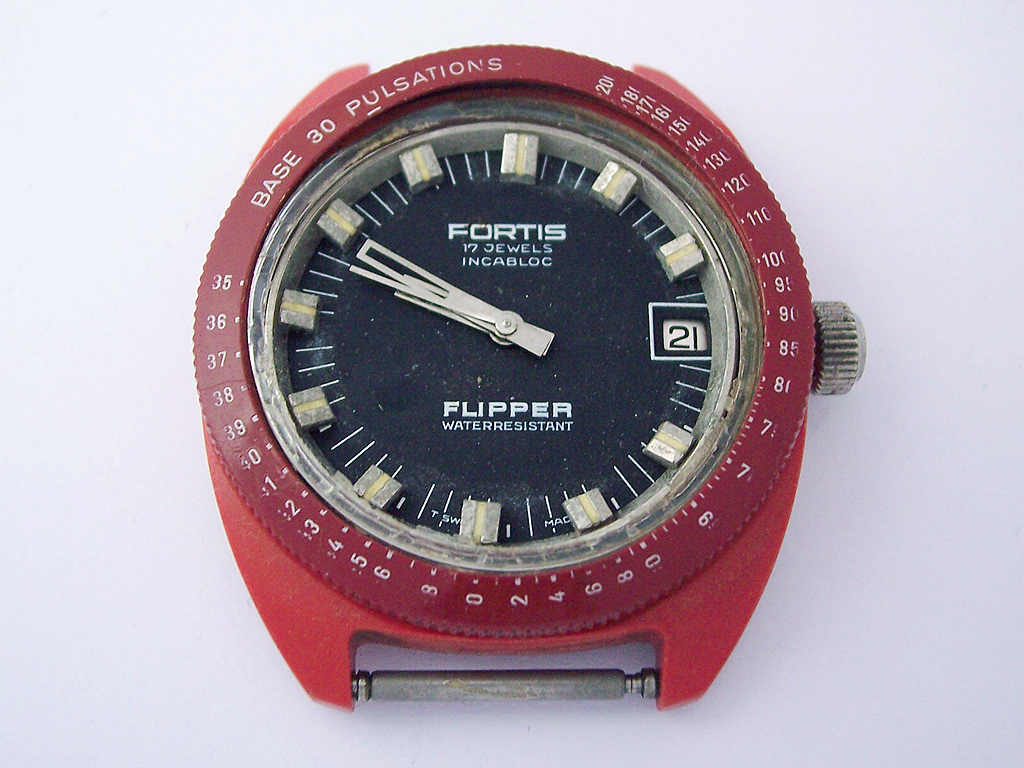
I’ve seen these watches quite a few times on my travels around the net, but I never realised what a significant model the Flipper was for Fortis. Researching this watch, I quickly fell into an information rabbit hole, accompanied by a dazzling array of models. I can’t possibly cover everything in one post, but here’s a potted history to get you started.
Launched in 1967 (some say to commemorate the 1968 Mexican Olympics, more on that later), the Flipper’s main attraction were their brightly coloured cases with five interchangeable bezels and a retail price of just $19.95 ($22.95 with date) – this is long before the Swatch craze, so brightly coloured watch cases were something of a novelty at the time.
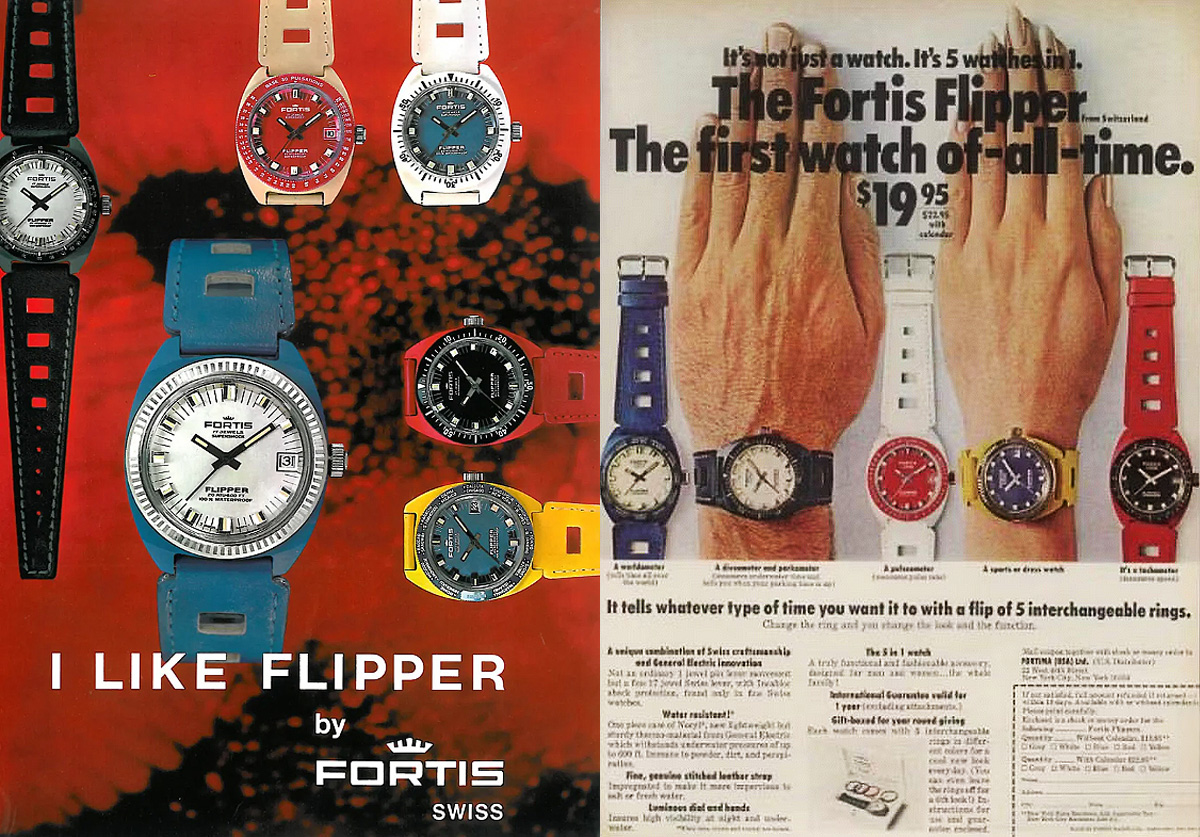
I’ve got no idea about sales figures for the early watches, but given how much effort Fortis subsequently put into the range, I’m guessing they were pretty popular.
The cases were made of Noryl, a new thermoplastic developed by General Electric Plastics in 1966. On paper, the properties of Noryl were ideal for watch cases; dimensionally stable (no warping), impact and heat resistant (minimal thermal expansion) and excellent hydrolytic stability (ideal for wet environments.)
The early watches were manually wound and the range was expanded later to include ETA powered automatics.
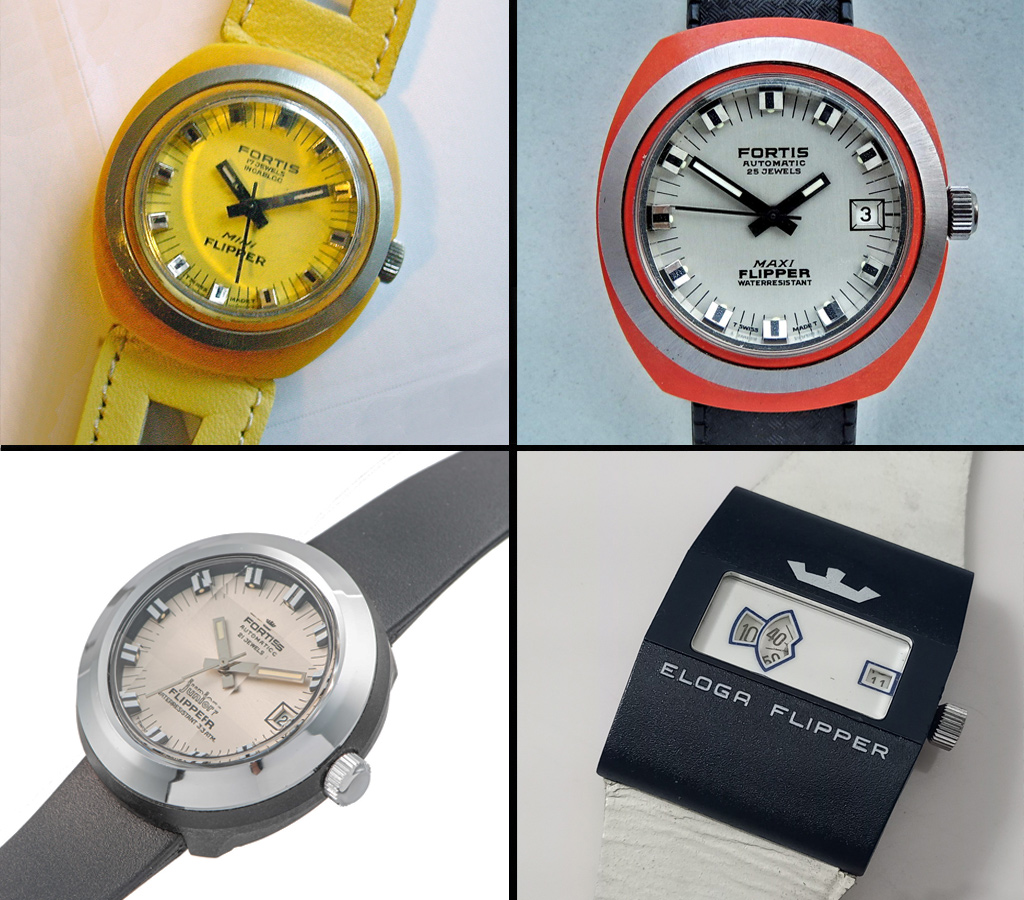
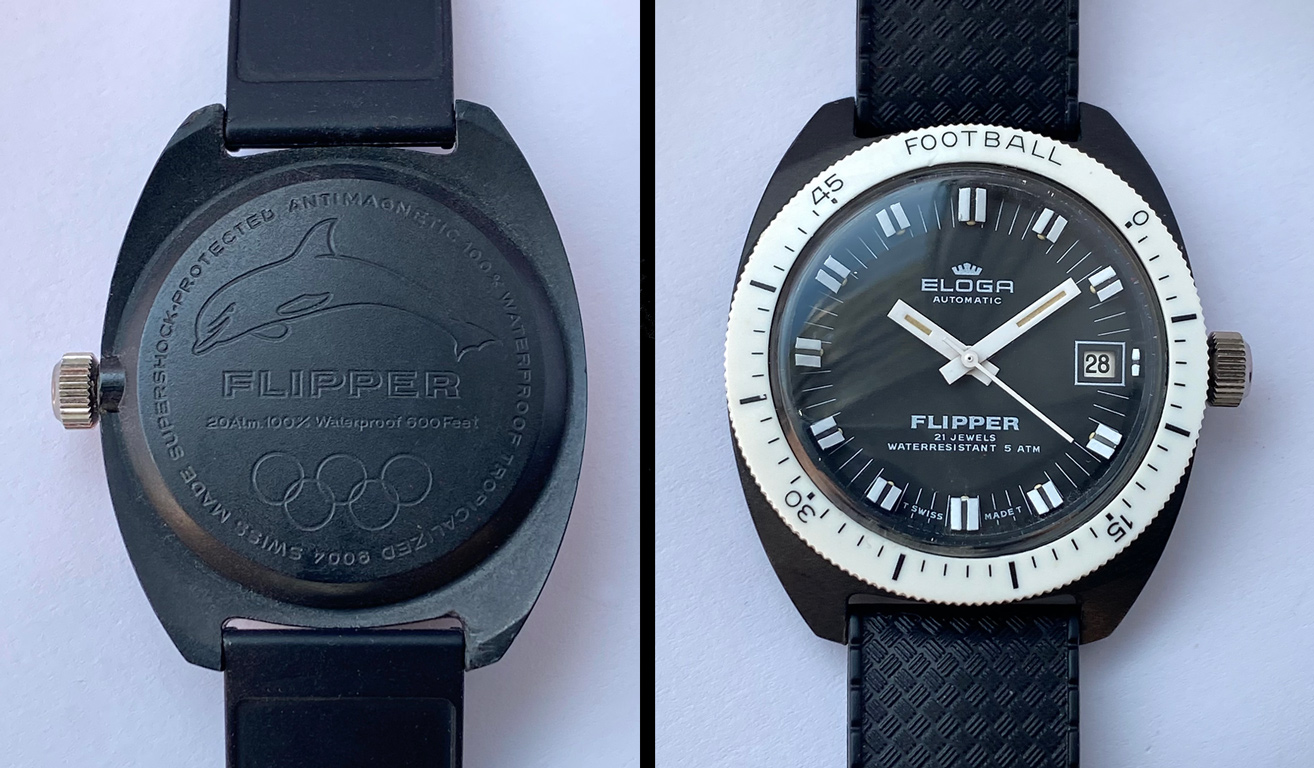
Identical watches were produced under different brand names too, Kurz and Eloga (a sub-brand of Fortis) being the most common. Subsequent mechanical models included the Mini and Maxi Flippers in completely different cases, a Junior Flipper and even a rare jump-hour Flipper.
The mechanical models were phased out and replaced by quartz versions in 1975, which proved even more popular. During the 1980’s the watches were seen on the wrists of various celebrities including Mick Jagger, Whitney Houston, Leonard Bernstein, Roman Polanski and Liza Minelli.
Casually dropping in a picture of a celebrity wearing the watch you’re restoring is always fun, but the only celebrity I could find sporting a Flipper was Roger Moore, seen here in this grainy picture beside Rolf Vogt, son of Fortis founder, Walter Vogt.

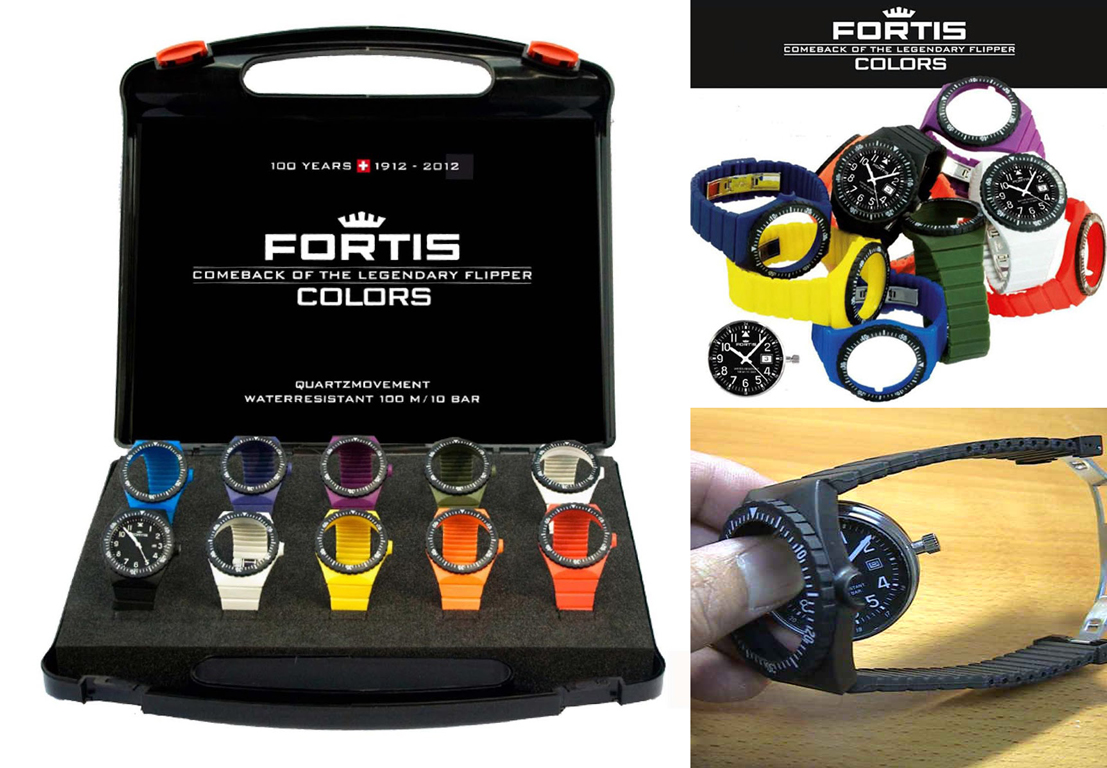
Fortis relaunched the Flipper concept as ‘Fortis Colors’ in 2012, to commemorate their 100 year anniversary. This time the (quartz) watch was a separate ‘pod’ which could be swapped into a variety of different strap and bezel combinations.
The subject of this post is one of the early manual models, this one with a date. Though it looks relatively complete in the first picture, it actually arrived looking like this…
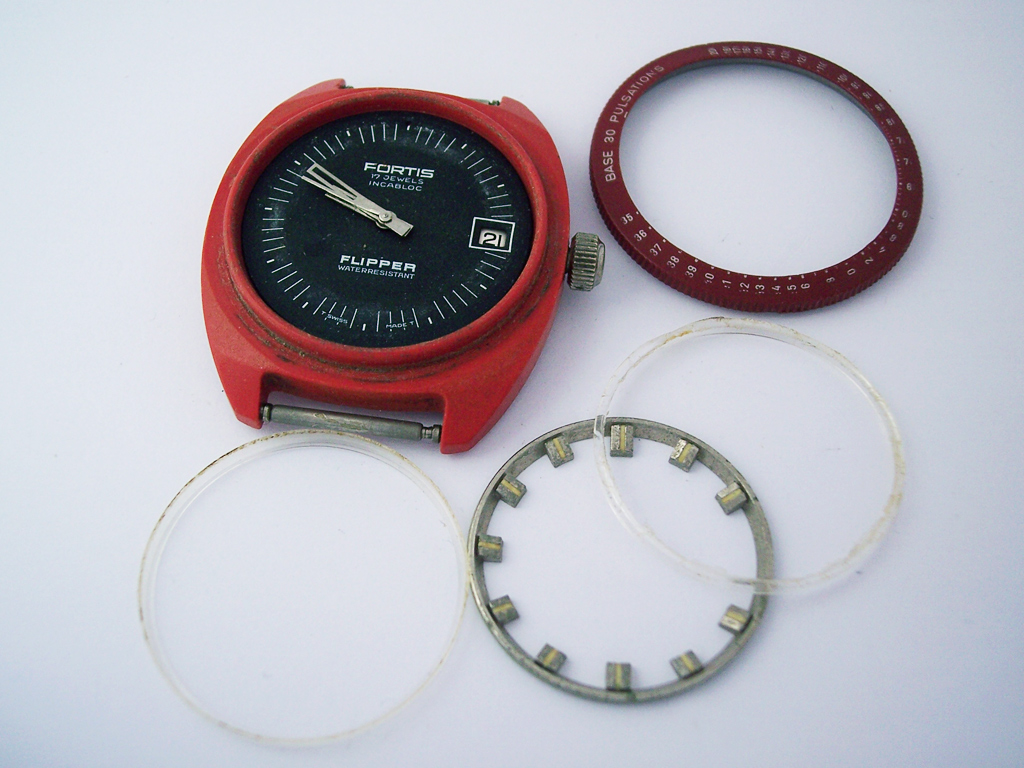
… and even in this state, I paid more for it than the original retail price of $22.95…. robbery! 🙂
The watch had obviously been sat for a long time without a crystal, the dial and chapter ring were completely covered in dirt and debris, and the hands were bent into all kinds of shapes. The metal part of the bezel too had been clumsily removed and was badly misshapen.
Turning the watch over, you can see the caseback markings, which include five distinct rings.
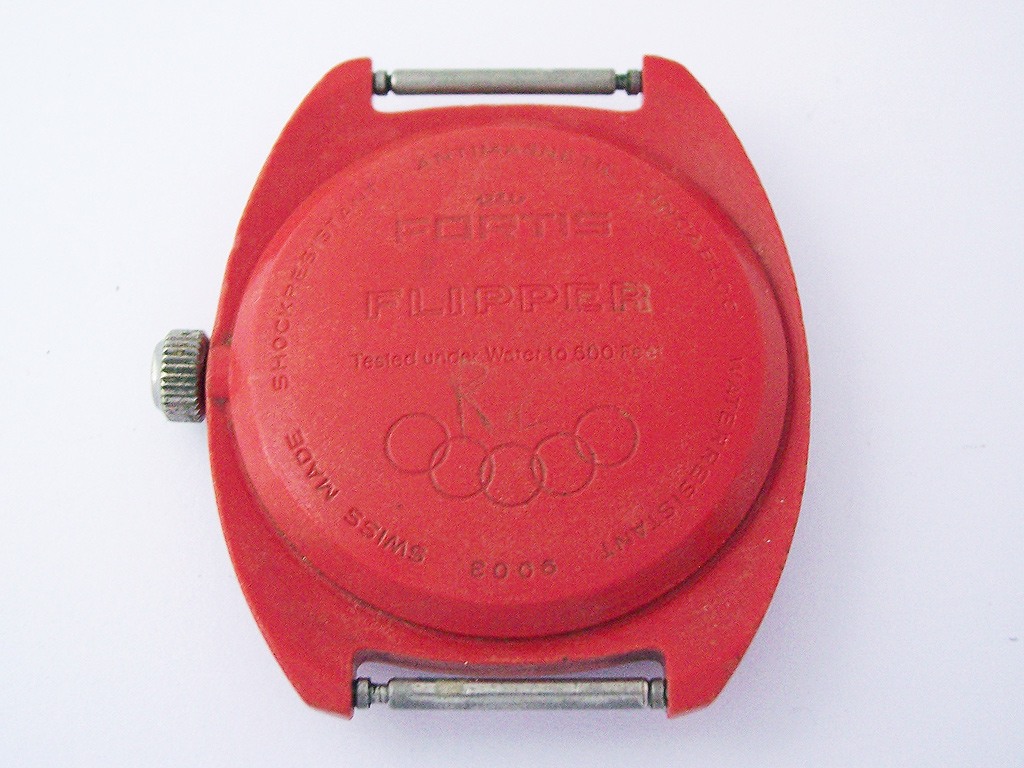
My money is on these representing the five bezels supplied with the watch, but on some models, these rings are arranged in more of an ‘Olympic’ fashion, which could give the impression that the watch was created to commemorate the 1968 Mexican Olympics. Credible? For me, the jury is still out.
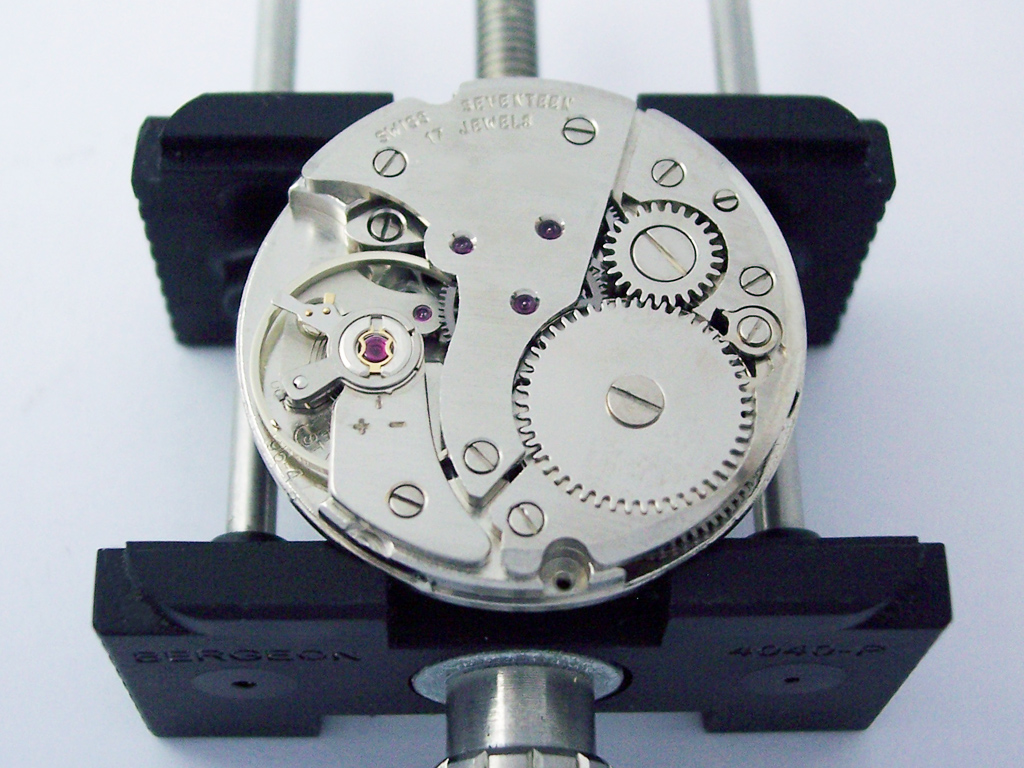
Splitting the winding stem and removing the watch from the case I found an unbranded Standard cal. 96-4, a 17 jewel manually wound calibre with date and a beat rate of 18,000 bph, which needed no more than a routine service to get it back up and running.
The hands were all straightened and cleaned along with the chapter ring. The lume was in poor shape throughout, so I removed and refreshed it all to make sure that everything matched.
The last thing to do was clean the case and replace the crystal. Thankfully, the base of the broken crystal was included with the watch, so I could measure it and find a suitable replacement. The chapter ring acts as the tension ring on this model, so the crystal had to modified slightly in order for everything to fit. After all that, the watch could finally be rebuilt.
It’s relatively easy to find a Flipper if you really want one, though few seem to have multiple bezels included. I only got one bezel with this watch and even that isn’t in great condition.
As you can probably tell from the pictures, the bezel is made from a completely different plastic to the case. It’s much softer as it has to stretch over the metal inner bezel in order to be interchangeable (there is no flex at all in the Noryl case).
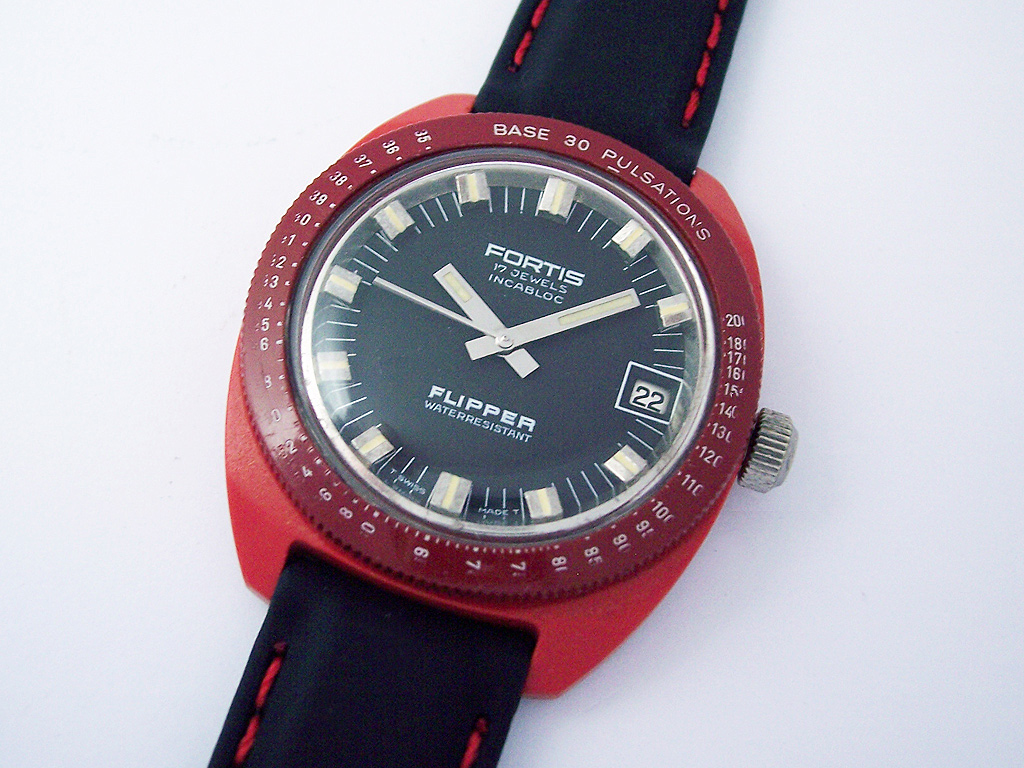
Unfortunately, worn bezels on Flippers seem to be the norm, especially after 50 years, as printing directly onto plastic could never be considered hard-wearing. However, from a ‘glass half full’ perspective, it’s a handy indicator as to how much wear the watch may have had… no bezel markings left at all? Avoid.
If I let my mind wander and do some “fag-packet maths”, if every Flipper was sold with five bezels, there must be thousands of them sitting around in drawers all over the world, so if you have a nice black bezel that still has good markings, hit me up. 😉
Finally, you may question whether it’s worth restoring a Flipper, as even when fully functional they are of limited value. For me it was, it kept me out of mischief on a rainy Sunday and with the research that followed, I know a lot more about the Fortis Flipper… and now, so do you. Congratulations if you made it this far!
Rich.
Thank you for this post! I bought a flipper my self but i have a model which i can’t identify the ref. Not there is info anywhere. It should be a mechanical only. 5 atm water resistant with date, supposedly from the 1990s. Have you seen these whilst researching for yours?