Wristwatch restoration, servicing and repair

Posts Tagged ‘Venus’

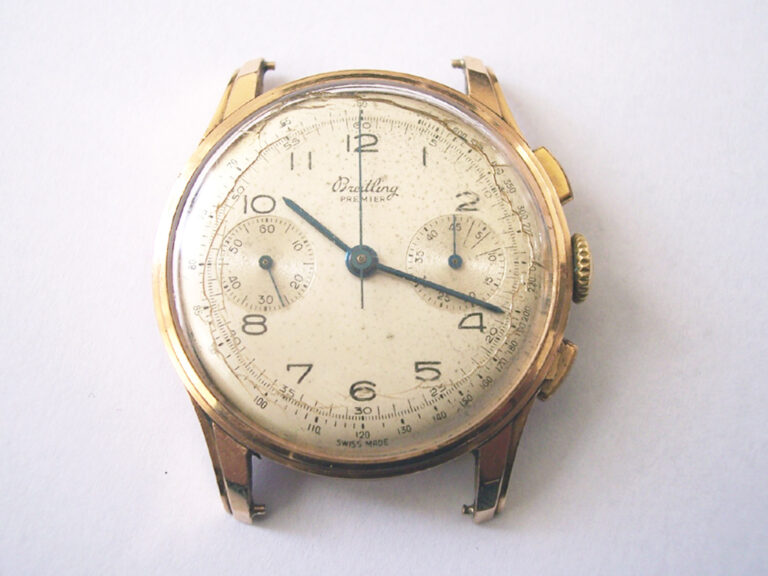
Breitling Premier (Venus Cal. 175)…

Here’s a great looking vintage Breitling that deserved some attention. These Premier chronographs are becoming quite collectible these days.

(Click pictures to enlarge)

‘Premier’ models were introduced during the 1930’s and were a long standing name in the Breitling lineup. Apart from two register chronographs, the lineup also included three register chronographs and elegant sub-second dress watches.  The name was retired in the 1960’s, but was re-introduced by Breitling between 1996 and 1999 in a limited edition production run of around 5000 watches. The re-issued model was fitted with Breitling’s own Cal. B40, based on an ETA Cal. 2892 with a Kelek chronograph module added.

Dating the one in this post proved to be quite easy as the engraved caseback gave a heavy hint as to its age. Quite a nice prize for winning the Class “B” league, I’m sure you’ll agree… I wonder what the Class “A” Champs got?. Using the serial number dated it precisely to 1946. (If you are interested in dating your own vintage Breitling, you can do so here.)

Over its production span, the Premier was fitted with a variety of chronograph calibres. Removing the caseback on this one revealed a quite tired looking, but complete Venus Cal. 175…

Most calibres are marked under the balance wheel with the manufacturer’s trademark and calibre number, but that wasn’t the case here. The dial and hands had to be removed first before the identity of the calibre was revealed.

The watch wasn’t running on arrival and obviously hadn’t been serviced for quite some time. Just to add to the fun, the hairspring had also been damaged, which proved even more entertaining as it was a Breguet overcoil rather than a flat hairspring (I wrote about the difference between the two types in this post).  After spending some time on it with the fine tweezers, everything was back in order again and the rest of the movement just needed a regular service.

Here is the watch after a clean and light buff for the case, and fitting a new crystal…

Rich.

** Many thanks to Helge Johnsen for letting me feature his watch on the blog. **


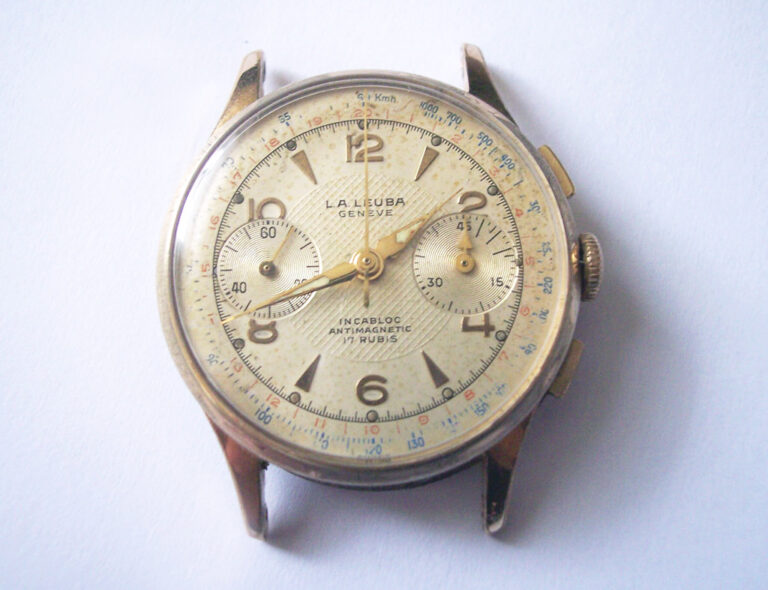
L.A. Leuba Chronograph (Venus Cal. 188)…

Another vintage chronograph, this time from the Swiss company L.A. Leuba…

L.A. Leuba is short for “Louis A. Leuba”, a company which surprisingly had no association with the much larger and well known Swiss manufacturer, Favre-Leuba.

The movement in this watch is a Venus cal. 188, a popular cam-lever chronograph calibre produced between 1949 and 1966 and can be found in many of the chronographs from that period.

After production ceased the design was used again by Valjoux in their cal. 7730 (the only modification was to the stud carrier, making it moveable to make beat correction easier). A few years later the design of the cal. 7730 was refined further and became the calibres 7733 and 7734 widely used throughout the 1970’s. Looking at a Venus 188 and a Valjoux 7734 side by side, it’s not hard to spot the lineage…

This particular watch arrived with a winding problem; it could be wound endlessly and the power reserve was less than 12 hours, which all pointed to a problem with the mainspring.

After removing the chronograph components it was plain to see that the mainspring had been heavily over oiled during the last service, the oil had leaking out all over the movement. However, after swimming through the oil the winding problem was quickly revealed, the mainspring had failed at the endpiece (inset)…

Judging by its condition, there is a good chance that this was the original carbon steel mainspring installed when the watch was first made. After many years of use (or less if you’re unlucky!) carbon steel springs can fail as they are susceptible to corrosion, often as a result of being handled during servicing. The problem is eliminated in modern mainsprings which are made from ‘white alloy’ (an alloy of cobalt, nickel, & chrome) and are corrosion resistant.

With a new white alloy mainspring ordered and installed, and the rest of the service completed, all that was left to do was renew the patchy lume on the hands. Although the dial shows its age a little, it has that great vintage look, and the movement is still in very good condition…

One last thing to notice about this watch are the three longer marks on the minute register at 3, 6 and 9 minutes. These marks were used to time telephone conversations back in the 1950’s when calls were charged in three minute intervals… if you talked for 10 minutes or more you probably couldn’t afford it!

Rich

** Many thanks to Marc Vos for letting me feature his watch on the blog. **