Wristwatch restoration, servicing and repair

Posts Tagged ‘Seiko’

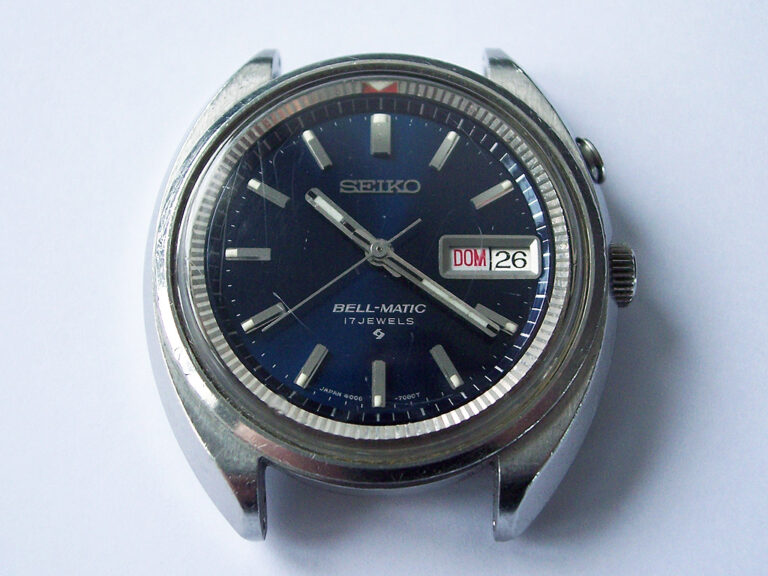
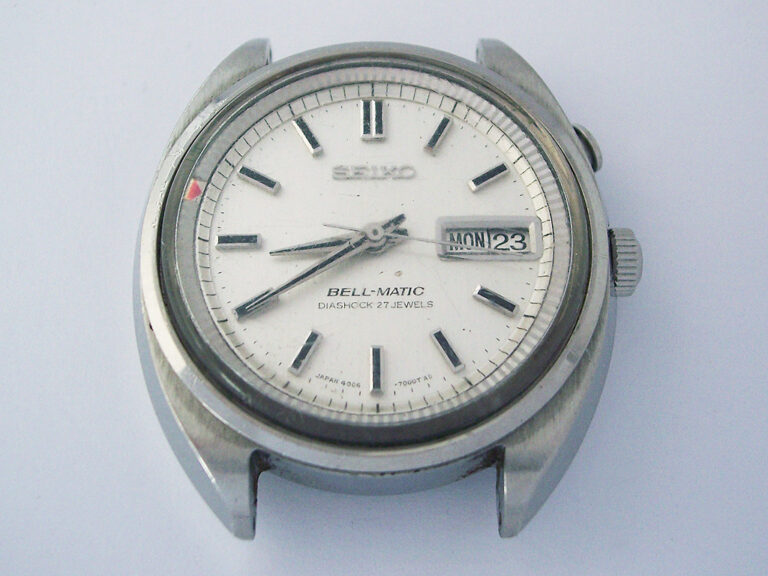
Seiko 4005-7000 (27J Bell-Matic)…

I’ve written quite a few posts about Bell-Matics and their calibres, but it’s been well over a year since one appeared on the blog. This one however is somewhat rare, and in some respects is the missing chapter of the story.

(Click pictures to enlarge)

What makes this Bell-Matic stand out from the crowd is that it has a date only calibre, the cal. 4005A, rather than the day/date cal. 4006A found in the majority of Bell-Matics.

The date only models were produced in the early days of the production cycle, and only for a couple of years before being phased out.  Only two models were available, the subject of this post (also available with a blue dial) and this one, available with either a black or white dial.

The cal. 4005A was only available in a 27 jewel version and like all Bell-Matic calibres, the jewel count is clearly displayed on the winding rotor, and the calibre number on the winding bridge.

The main difference between this calibre and the 4006A is of course the calendar mechanism. With the dial removed, comparing the two calibres you can see that the advancing wheel and day jumper found in the 4006A are missing from the calendar plate on the 4005A.

In terms of other differences, the unlocking wheel has no raised boss for the day disc, and the date ring is not as deeply recessed as no additional space is needed to accommodate the day wheel.

Other than that the calibres are identical from a technical perspective, but there are subtle differences in the case designs for the two model lines. The date only models use a different crystal for example.

Although running on arrival, this Bell-Matic had ‘lost it’s voice’. The alarm wouldn’t wind up any more, which all pointed to either a problem with the crown wheel or a broken alarm mainspring.

Sure enough, the problem turned out to be broken alarm mainspring, so with that replaced and the rest of the movement serviced, it was back up and running again.

Rich.

** Many thanks to Neil Lever for letting me feature his watch on the blog. **


Seiko 6138-0030…

Here is another one of Seiko’s popular 6138 chronographs from the 1970’s, and one of my favourites…

(Click pictures to enlarge)

The owner of this watch bought it new in the 1970’s and wore it regularly, until condensation started appearing on the inside of the crystal, a sure sign that the gaskets needed to be replaced. A local watch repair shop agreed to service the movement and fix the leaking problem, but couldn’t source the correct gaskets, so rather than risk any further damage the watch remained unworn.

When assessing the watch on arrival I noticed a grinding noise from the automatic winding mechanism which would need further investigation. With the caseback removed, everything looked to be in order…

… but when I removed the winding rotor, it was clear that something was wrong as the rest of the winding mechanism simply fell apart. The bearing housing of winding bridge was broken, the ball bearings were scattered all over the movement, and the transmission wheel had been snapped in two (although curiously there was only half of it inside the watch?).

Apart from the winding problem, the rest of the movement was in good condition, so with the broken parts replaced and the movement serviced, it was time to turn my attention to the cosmetic issues.

As you can see in the first picture, the crystal had picked up its fair share of scratches and the luminous filling on the hands had darkened over the years, both of which would need to be replaced. A full set of gaskets would also be needed to cure the ‘fogging up’ problem.

After installing the new parts, reluming the hands, and giving the case and bracelet a thorough cleaning, here is the result. The watch still has the original ‘fishbone’ bracelet, which is always nice to see.

Rich.

** Many thanks to Mircea Radulescu for letting me feature his watch on the blog **


Seiko 6139-6009…

I recently bought a number of these models in various states of disrepair, the most interesting of the bunch being this one, a 6139-6009 from 1970…

(Click pictures to enlarge)

Known as the “Pepsi Chrono” because of the blue and red bezel insert, this particular watch is one of the earliest models which has a number of subtle differences that were phased out in later versions. When looking at the case you will notice a small section has been cut out to allow easier access to the crown, the dial has ‘Water70MResist’ written on it, and the centre second hand is the thin, two piece version only seen on early 6139 models.

While the blue dialled version is popular, there is also a gold dialled version which is even more popular. It is also claimed to be the first automatic chronograph worn in space as Col. William Pogue wore one on the Skylab 4 missions in 1973. (More information can be found here).

Although the 6139 arrived in non-running condition and missing it’s crown and stem, it had a lot of things in its favour. The dial and hands were in very good condition, still with clean original lume and the inner bezel had no fade at all.

A missing stem and crown is a very common problem with these watches and if the operation of the rotating inner bezel is to be maintained, exactly the right parts need to be sourced. I wrote about how inner bezels work in a previous post, click here if you missed it.

The movement just needed a service to bring it back to life, so with a new stem, crown, inner gear and spring all located, all that was left to do was fit a new crystal to finish the job…

(Notice also that the bracelet is the same width all the way from the watch head to the clasp. On later models, it flared where it joined the case. All subtle details, but important if you are interested in originality).

Finally, here is an advert for this watch claiming it as the “All Man Man’s Watch”. I’m not sure such cheesy advertising would make the billboards today, but it’s a great line…

Rich.


Seiko 6105-8110…

This watch is one of Seiko most popular vintage divers… well almost! The 6105 series of divers watches were produced between 1968 and 1977 and if you’re familiar with them you’ll know instantly that something isn’t right here, the case looks all wrong…

(Click pictures to enlarge)

Giving it a quick look over on arrival I presumed it was the internals from a 6105 diver transplanted into a newer case, so I set it to one side for attention later. When I came back to it and turned it over I was very surprised to see the straight brushed finish of a regular 6105 case on the back…

Closer inspection revealed that the case was an original, but had been ground down to give it a much slimmer profile. Apparently this practice was quite common in SE Asia during the 80’s and 90’s, perhaps it was considered too bulky for everyday use, who knows?

I have to say that the finish was very good and almost symmetrical, just the area around the crown guard had traces of the grinder still showing through…

As you probably noticed in the first picture, the dial and hands were badly aged. As it had been heavily modified already, the owner was more interesting in having a presentable watch to wear, so I serviced the movement and replaced the dial, hands, glass and bezel insert.

Here’s the result…

… and here is how it would have started life, quite a difference!

Rich.

** Many thanks to Menno van Rij for letting me feature his watches on the blog. **


Seiko 6138-0040 (Bullhead Chronograph)…

As you may have read in a previous post I bought these two Seiko Bullheads for restoration in a single deal…

It won’t come as a major surprise but these watches are called ‘Bullhead Chronographs’ because with the crown and pushers on the top of the watch rather than the side it makes them look like, well… like a bull’s head! The Bullhead design first appeared in the 1960’s, but it really took hold in the1970’s with some of the major manufacturers getting in on the act, Omega being one of them…

It’s safe to say that the watch designers had some real fun with the Bullhead. Here are a few others that make the design of the Seiko look tame in comparison…. well, it was the 1970’s after all.

Sorna had quite a few Bullheads in their line up, this Jacky Ickx Easy Rider World Time model being a hard one to miss…

A similar Jacky Ickx model was also available in gold… ‘bling, bling’…

At a huge 60mm wide this Desotos model really separated the men from the boys…

… and finally, though not quite as ‘out there’ as some, this Tissot Sideral stood out from the crowd by combining yachting, football and slide-rule scales on the dial and then wrapping it all up in a unique fibreglass case, complete with rotating bezel and built in leather strap.

Getting back to my own watches, having covered the major points of the restoration in part one of this post (here if you missed it), there isn’t much to tell this time.

With the second of the two watches I was having some trouble with the reset mechanism, but everything turned out well in the end. So, after a thorough cleaning and a new set of hands, here is the result…

If you want to see more Bullheads from the past check out this great post on the blog The Watchismo Times.

Rich.