Wristwatch restoration, servicing and repair

Posts Tagged ‘Tissot’

Tissot Seastar Chronograph (Lemania Cal. 1277)…

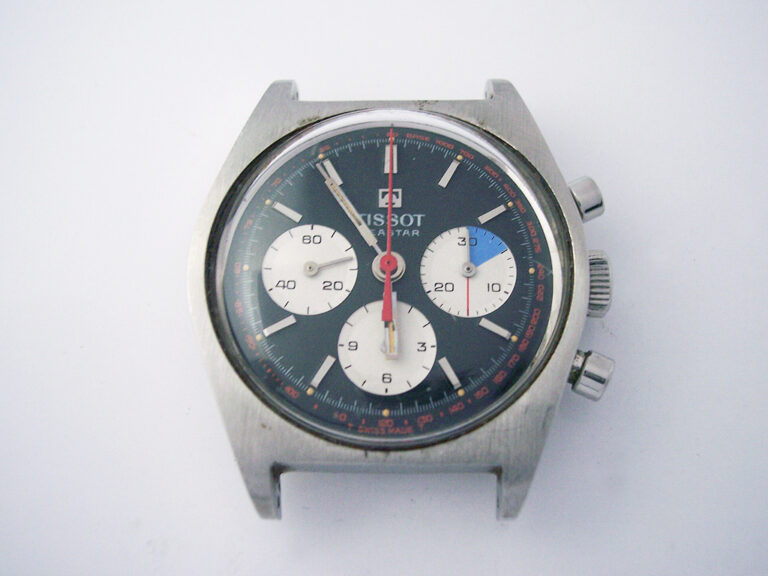
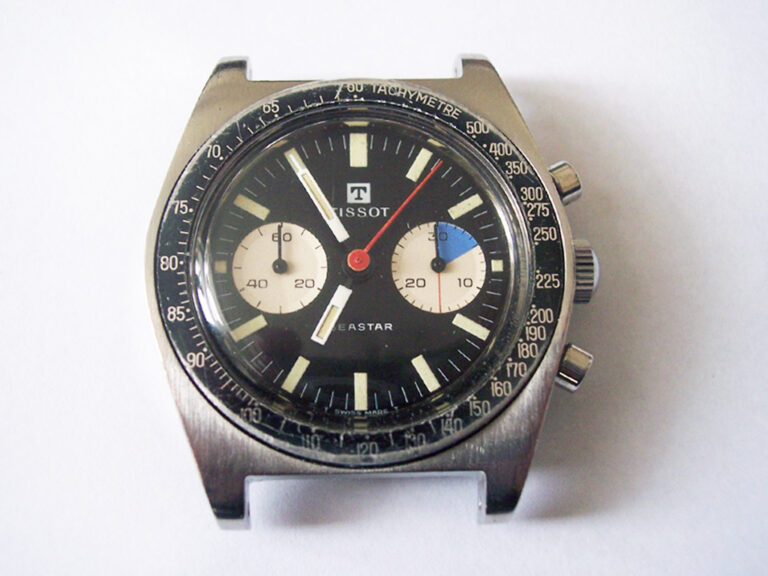
Another vintage Tissot chronograph, this time a Seastar model from the late 1960’s.

(Click pictures to enlarge)

This watch arrived in running condition, but had problems with the chronograph mechanism. It would stop as soon as the minute register started to advance, suggesting a problem with the depthing of the wheels in the chronograph mechanism.

The movement in this watch is quite interesting as it is one of the rarer Lemania calibres, the cal. 1277.

What makes it interesting is that it was only produced in 1969 and was used almost exclusively in a handful of Tissot chronograph models from that year. After 1969, the cal. 1277 was modified slightly and renamed as the Tissot cal. 872.

My initial suspicions about the chronograph problem proved to be unfounded as disassembling the watch revealed that it had been seriously over-oiled in the past.

This had obviously been done many years ago as the oil had thickened to a paste and the problem with the minute register was immediately apparent. The chronograph heart was literally stuck to the underside of the bridge with old oil.

After a thorough cleaning the movement was back up and running again and after polishing the crystal and cleaning the case, here is the result.

Though the pictures don’t really show it, at 36mm wide, this watch is quite small for a chronograph. Here is a picture of it with a couple of its stablemates from the same era to give you an idea of its size.

Rich.

** Many thanks to Anders Wengman for letting me feature his watch on the blog. **


Tissot Seastar Electronic (ESA Cal. 9154)…

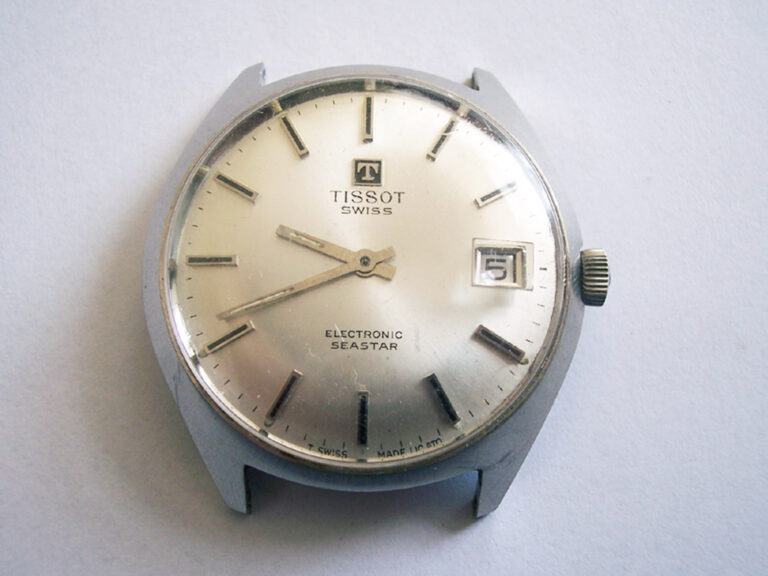
To quote Monty Python…. “And now for something completely different”. A Tissot Seastar Electronic.

(Click pictures to enlarge)

From the front there is little to distinguish this Tissot Seastar from many of its 1970’s stablemates. The word ‘Electronic’ on the dial is a clue that there is something different going on here, and opening the caseback reveals an electronic or transistorised calibre, the ESA cal. 9154 Dynatron.

Transistorised watches form an interesting chapter in wristwatch history. They were first introduced between the true electric watches of the 1950’s, such as the Hamilton 500, and the earliest quartz watches which appeared on the market in 1967.

They can be thought of as hybrid calibres in that they have a balance, hairspring and regulator just like a mechanical calibre, but the mainspring is replaced by a battery and an electronic module. The obvious advantage is that being battery powered they never need to be wound, but also the power from the battery remains constant unlike the torque from a mainspring which varies depending on the state of wind.

To say that the watch has a traditional balance assembly isn’t exactly true, here is a picture of the balance suspended on a balance tack.

The balance wheel consists of two discs which pass above and below the induction coil on the electronic module as the balance rotates. On each disc are two magnets which are used to convert the electric charge from the induction coil into electromagnetic energy. You can see the magnets on the lower disc in the picture above, the upper disc has two identical magnets on the underside.

To compensate for the weight of these four magnets, the lower disk also has a counterweight (see inset). As the balance wheel has to be poised to minimise positional errors, just like a traditional balance wheel, several holes are drilled into the counterweight to achieve this.

At the heart of the calibre is the electronic module, which consists of a stop contact, a transistor, two capacitors, a resistor, and two induction coils. Although it looks like a single induction coil it is actually two coils wound together, one is connected to the base contact of the transistor and the second to the emitter.

Here is how it works. The key to the circuit is the transistor which acts as a switch. As the first pair of magnets on the balance wheel pass over the induction coils and a positive current is induced in the coil connected to the base of the transistor. This current effectively ‘opens’ the transistor and allows a larger flow oc current from the capacitor/battery through the transistor and down through the second induction coil.

While this is happening the balance rotates further and the second pair of magnets are over the coils just as the second coil is charged which repels the magnets, giving an electromagnetic push to the balance wheel. When the balance returns in the opposite direction, the first pair of magnets induce a negative current in the coil which ‘closes’ the transistor, cutting the power from the battery.

The system is undoubtedly ingenious and it is a shame that this invention, along with many others, was effectively “kicked into the long grass” with the introduction of quartz watches. You still see a few of these watches around, but they aren’t really that collectible due to the lack of available spare parts and difficulty of repair.

I bought the Tissot in a non-running state which was a bit of a gamble, but I did have another watch with the same calibre which I could use as a donor, so I was confident that I would be able to make one good watch out of the two.

The original hands were pretty tired so I found some suitable replacements, and after cleaning the case, fitting a new crystal and battery, the restoration was complete.

Rich.


Tissot Navigator (Lemania Cal. 1341)…

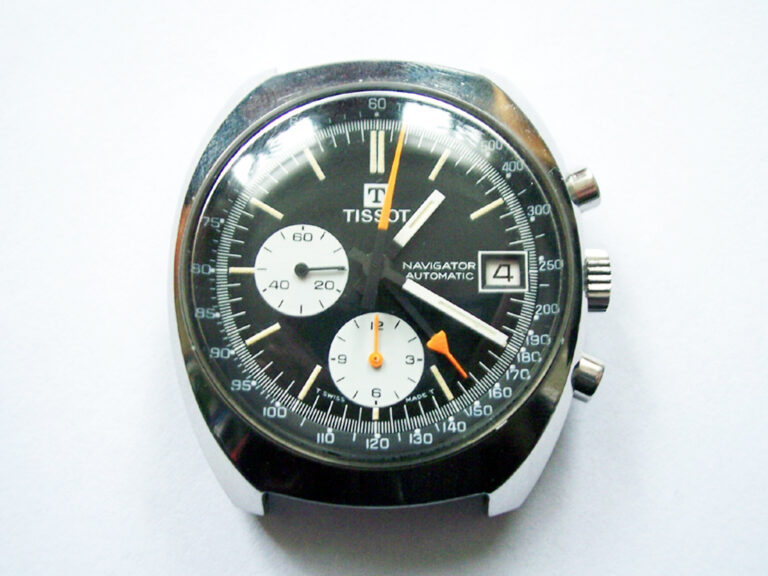
Another Tissot on the blog, and another chronograph, this time a Navigator from the 1970’s…

(Click pictures to enlarge)

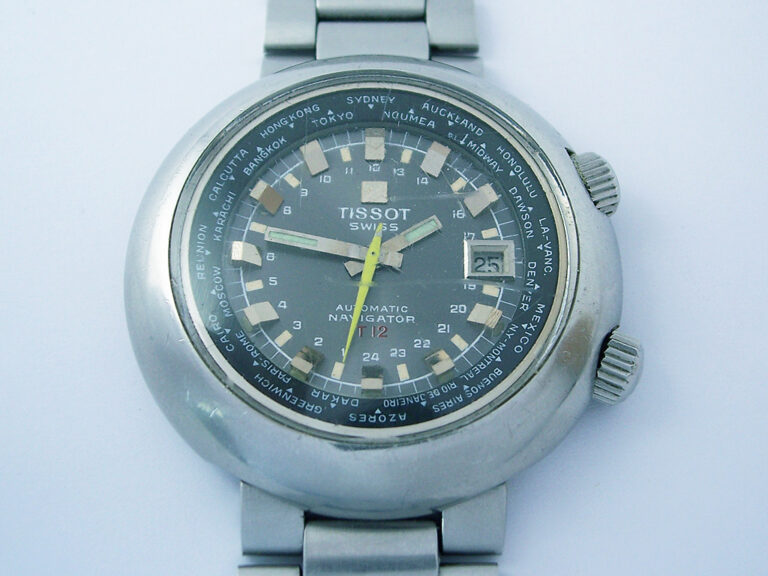
During the late 1960’s and 70’s, Tissot had a range of chronograph models with the titles Seastar or Navigator (or both) featuring a variety of calibres, some hand wound (Lemania 873, Valjoux 7733/4) and some automatic (Lemania cal. 134x, cal. 5012).

The movement in this watch is a Lemania cal. 1341, an automatic, three register, cam lever chronograph. What makes this calibre interesting, both technically and visually, is that the minute register for the chronograph is not presented in a subdial, but as a separate minute hand that sweeps around the dial. The subdials in this calibre are an hour recorder at six, and running seconds at nine ‘o clock.

The cal. 1341 is a simplified version of the cal. 1340 which was first introduced in 1972. The main difference between the two is that the cal. 1341 has 17 rather than 22 jewels, and has no facility for adding a 24 hr function. The 1340/1 calibres are often linked with the Omega calibres 1040/1 and for good reason as they are almost the same, apart from a few technical improvements and an Omega rather than a Lemania branding.

In the 1930’s Tissot, Omega and Lemania formed a working group called La Societe Suisse pour l’industrie Horlogere (SSIH) which was the predecessor of Swatch Group of today. Therefore,  it is not a really surprising to see Lemania based calibres appearing in the watches of all three brands.

Removing the winding rotor from the movement reveals the heart of the cam lever mechanism…

Power for the mechanism is provided by the driving and coupling wheels, just like a traditional chronograph calibre. When starting and stopping the chronograph the position of the cam controls the raising and lowering of the coupling wheel onto the centre second wheel. When resetting, the coupling wheel is disengaged from the centre second wheel and the reset hammer moves across to return the centre second wheel back to the zero position. Also attached to the cam is the coupling yoke which provides the link to the hour and minute registers on the dial side of the movement.

Turning the movement over and removing the calendar plate and mechanism bridge, you can see that the rest of the chronograph functions…

In the picture above the mechanism is in”stopped” condition. You can see that the minute recorder clamps are in contact with the minute recording wheel holding it in position, and the hour recorder stop lever is arresting the hour recording wheel.

When the chronograph is started, the hour recorder stop lever pivots around it’s securing screw pulling back the valet which prises the minute recorder clamps open. The minute recording wheel then turns along with the cannon pinion on which it sits. The hour recording wheel is also released and turns along with the mainspring barrel.

As the watch was already in good cosmetic condition, it needed no more than a service to ensure it was as good inside as outside. Here it is all back together again.

Rich.


Tissot Visodate (Cal. 782-1)…

Another Tissot Visodate, this one slightly younger than the last one, dating to the late 60’s or early 70’s and rather than an automatic movement, this one was fitted with a manually wound cal. 782-1…

(Click pictures to enlarge)

The problem with this watch was pretty easy to figure out as it would wind a little and then you would hear a ‘buzzzzzzz’ from inside and the watch would stop… all the hallmarks of a broken mainspring. In hand wound watches the spring is hooked onto the inside of the barrel wall and if too much force is applied to the crown when fully wound, the spring can break.

To prevent this from happening it’s advisable to stop winding a manually wound watch as soon as you start to feel resistance, rather than winding it until it won’t wind any more.

With a new mainspring fitted, the rest of the movement was brought up to scratch with a clean and oil…

One other area letting this watch down was the hands which had been badly treated in the past and were so bent out of shape that they had been rubbing together. At some time in the past I bought a batch of vintage Tissot hands which as luck would have it were exactly the right size and length. Though they were a different shape, they suited the watch nicely.

After sorting out the hands, all that was left to do was fit a new crystal. Although it’s not a visually exciting model, the watch has a great caseback and still has it’s original crown and bracelet which is always a bonus…

Rich.


Tissot Visodate (Cal. 28.5R-621)…

Arriving in a scruffy state, this 1950’s Tissot Visodate looked like it had potential under the scuffed up crystal…

(Click pictures to enlarge)

Inside this watch is one of Tissot’s earliest automatic calibres, the 17 jewel Cal. 28.5R-621. Though not running the movement was in pretty good condition, but some of the screwheads needed extra attention as they were tarnished…

Polishing screwheads by hand is a tricky business as it’s almost impossible to keep the edges sharp. The best way to do it is to use a screwhead polishing frog…

Don’t ask me why they call it a ‘frog’, but here’s how it works. The screw is clamped into the underside of the frog and the two knurled screws at the opposite end are raised or lowered accordingly to ensure that the screwhead is perfectly flat for polishing.

Depending on how bad the head is, the polishing starts with emery paper and then moves through finer grades of polishing paper to restore a mirror finish. Here’s a before and after shot…

With the screwheads polished, the rest of the movement just needed a clean and oil to bring it back to life, so with a new crystal and a good clean for the case, the job was complete.

Rich.