Wristwatch restoration, servicing and repair

Posts Tagged ‘Oris’

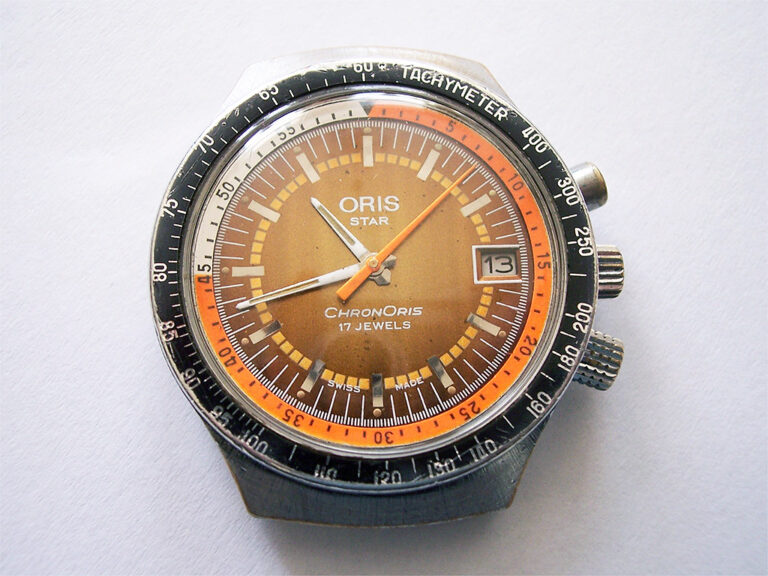
Oris Star ChronOris…

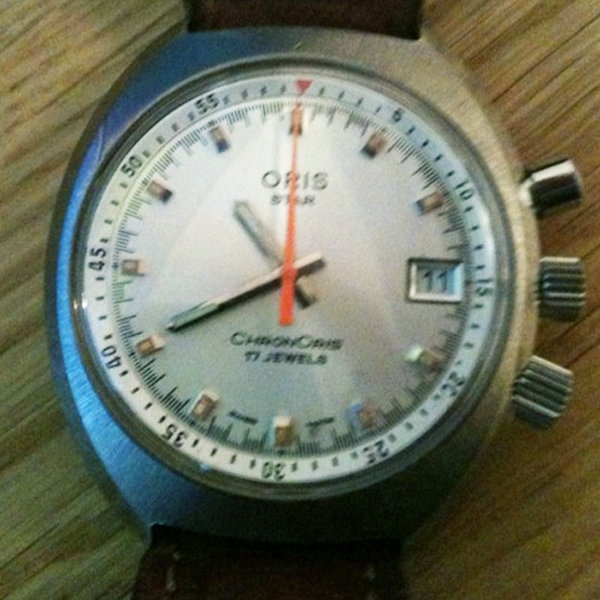
When introduced in 1970, the ChronOris was the first Oris watch with a chronograph function. I was very surprised to find this one locally, and it’s the only one I have ever seen with an orange dial…

(Click pictures to enlarge)

Over the years this watch was made with a number of different dial designs and two different shaped cases; a cushion shaped case and the one like mine with an external Tachymetre bezel….

You may have noticed that unlike a conventional chronograph, the ChronOris only has one pusher, successive pushes of which start, stop and reset the sweep hand back to zero.

You may have noticed too that the watch has no minute counter, but don’t worry you don’t have to keep track of the minutes yourself as the inner orange/white bezel can be rotated using the crown at 3 o’clock. By lining the pointer up with the current position of the minute hand, you can time events of up to 60 minutes. The knurled crown at 4 o’clock takes care of winding the watch and setting the time and date.

Inside this watch is the Oris cal. 725; a 17 jewel, 18,000bph, manually wound calibre with a chronograph mechanism which was designed and developed in conjunction with Dubois Dépraz, the renowned chronograph specialists.

Here are a few pictures of mechanism in action, the first one shows the mechanism when the pusher has been pressed for the first time, starting the chronograph…

The power for the mechanism comes from the transfer wheel which is attached to the fourth wheel in the going train, so turns continuously (along with the intermediate wheel) whether the chronograph is engaged or not.

The key to the whole mechanism is the column wheel whose position determines which levers or wheels are affecting the chronograph centre wheel. You can see that the lever attached to the intermediate wheel is currently between two pillars on the column wheel so the intermediate wheel is now in contact with the chronograph centre wheel. As the sweep second hand is attached to the axle of the chronograph centre wheel, on the dial side of the movement, the sweep second hand would now be moving.

A second press of the pusher stops the chronograph…

The pusher moves the column wheel around, disconnecting the intermediate wheel from the chronograph centre wheel, the brake lever falls in between the pillars of the column wheel and contacts the chronograph centre wheel, holding it in it’s current position.

A third press of the pusher resets the sweep hand back to zero…

The pusher moves the column wheel around again, lifting both the intermediate wheel and brake away from the chronograph centre wheel. This time the hammer falls between the pillars of the column wheel and moves across to contact the chronograph heart, rotating it back to zero from the stopped position.

With the movement back together I cleaned the hands and dial as best I could, cleaned the case and polished the crystal. It is still possible to order new crowns and pushers from Oris, but as the Tachymetre bezel is no longer available there didn’t seem much point. The watch shows it’s age here and there but I don’t mind, I’m going to enjoy it just as it is…

I couldn’t find much information about the original ChronOris, but I did read that only 27,000 examples were made, which seems like a small amount for such an iconic Oris model.

To commemorate the original, Oris released a new version of the ChronOris in 2005, based this time on the Valjoux 7750 calibre adding a second pusher, a 30 minute counter and automatic winding functions while still retaining the retro styling of the original…

If anyone has any more details about the original ChronOris it would be great to hear from you.

Rich.


Oris Cal. 581…

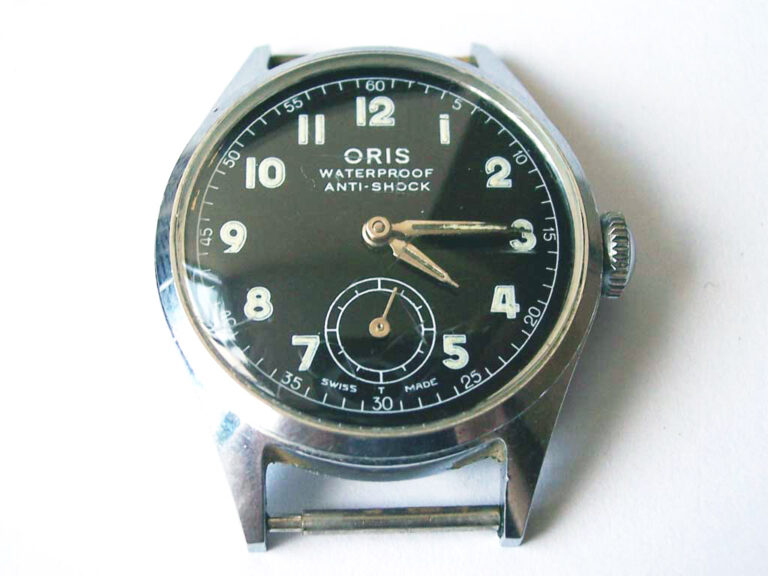
Another vintage Oris, this one from the 1940’s or early 50’s. It arrived in much better cosmetic condition than I was expecting, the case, dial and crown were near perfect…

(Click pictures to enlarge)

It wasn’t running and I initially thought the problem may have been this huge hair left in there by the last (blond!) watchmaker… yikes! Alas, I wasn’t that lucky and on further inspection found that one of the pins on the pallet lever had been snapped off (inset).

I had a couple of old Oris movements lying around from which to salvage a pallet pin (as you do!), so after carefully levering out the broken pin and replacing it, we were back in business.

Oris were one of the few watch companies to take the manufacture of pin lever movements seriously, especially in the 1940’s and 50’s, when they were prevented from producing jewelled lever watches by a Swiss law (designed to protect the big manufacturers from competition).

Undeterred, they continued to refine their best pin lever movements, eventually rivaling the precision watches of the day, and even obtained a number of C.O.S.C. certificates along the way. No mean feat!

With the movement up and running, I relumed the hands, replaced the crystal and the watch looked like new again, both inside and out.

Rich.


Oris Cal. 440…

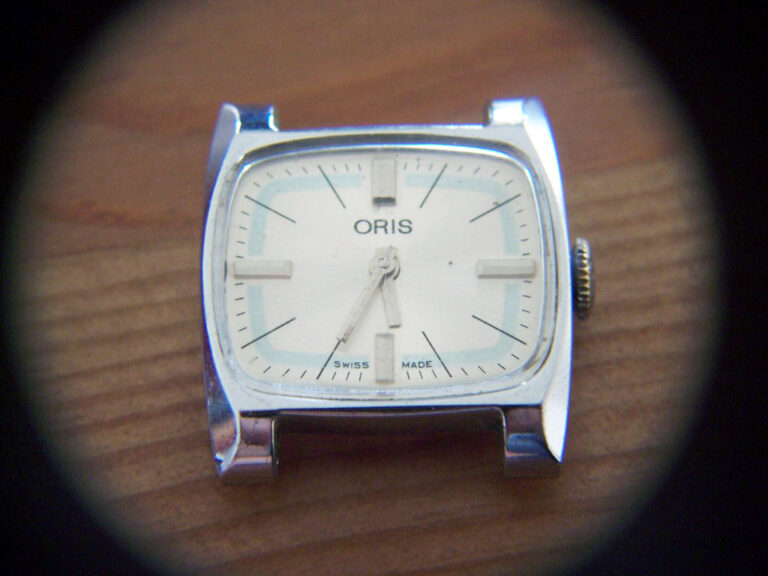
I picked up this ladies Oris as a birthday gift for a certain someone in the Netherlands (Hoi!). From what I can gather it was made in the late sixties or early seventies, but dating vintage Oris watches with any accuracy can be quite difficult as even Oris doesn’t have any records of production dates and numbers.

(Click pictures to enlarge)

Working on this one was a real treat, no calendars or automatic winding complications to deal with. The movement hadn’t been running for some time as the stem had been bent preventing the watch from being wound. Luckily, I managed to source a replacement and it was straightforward from there. All cleaned up it runs nicely and being a pin-lever escapement it’s got a lovely loud tick.

It’s still in great cosmetic condition with just a little wear on the crown and a few marks on the case. I thought about replacing the crown with something a bit more modern but decided to leave it as original as possible. I think it’s great, I hope she likes it.

Rich.


Oris Cal. 461…

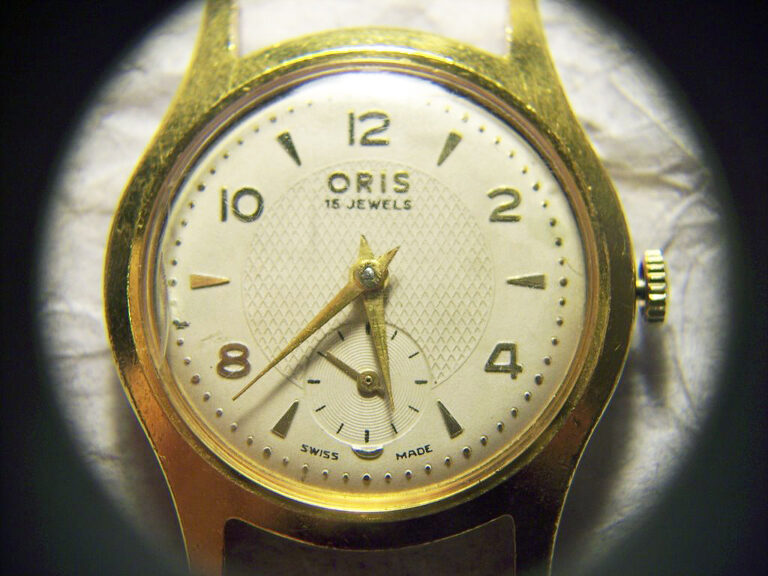
This vintage Oris dates back to the 1950’s and would originally have been worn as a mens dress watch, but at 31mm wide is almost considered a ladies watch by today’s standards. The watch was in reasonable condition but showing it’s age on the textured dial and hands.

(Click pictures to enlarge)

The movement is a 15 jewel manual winding caliber with subseconds. The difference between subseconds and centre sweep second movements is the position of the fourth wheel in the going train. In centre sweep movements, the fourth wheel has it extended pivot running through a hollow centre wheel and cannon pinion, while in subsecond movements the centre wheel and cannon pinion are solid and the fourth wheel is positioned directly between the third and escape wheels.

(Click picture to enlarge)

The gold plated case is in very good condition for its age but I couldn’t do anything about the marks on the dial. Textured dials from this period are very difficult to clean effectively. I’m not exactly sure what the dial is made from but I wasn’t going to risk any kind of liquid on it.

Even with the visible flaws, it’s still a nice looking watch that runs beautifully. Another interesting project.

Rich.