Wristwatch restoration, servicing and repair

Posts Tagged ‘Lemania’

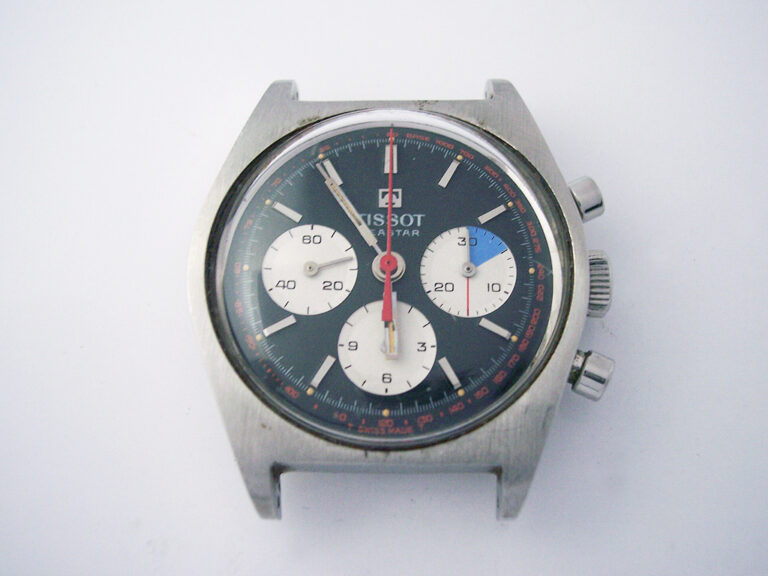
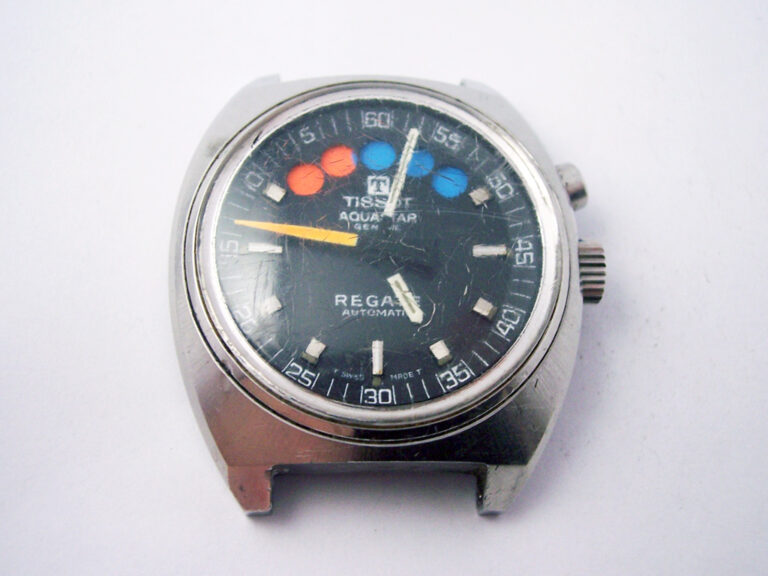
Tissot Seastar Chronograph (Lemania Cal. 1277)…

Another vintage Tissot chronograph, this time a Seastar model from the late 1960’s.

(Click pictures to enlarge)

This watch arrived in running condition, but had problems with the chronograph mechanism. It would stop as soon as the minute register started to advance, suggesting a problem with the depthing of the wheels in the chronograph mechanism.

The movement in this watch is quite interesting as it is one of the rarer Lemania calibres, the cal. 1277.

What makes it interesting is that it was only produced in 1969 and was used almost exclusively in a handful of Tissot chronograph models from that year. After 1969, the cal. 1277 was modified slightly and renamed as the Tissot cal. 872.

My initial suspicions about the chronograph problem proved to be unfounded as disassembling the watch revealed that it had been seriously over-oiled in the past.

This had obviously been done many years ago as the oil had thickened to a paste and the problem with the minute register was immediately apparent. The chronograph heart was literally stuck to the underside of the bridge with old oil.

After a thorough cleaning the movement was back up and running again and after polishing the crystal and cleaning the case, here is the result.

Though the pictures don’t really show it, at 36mm wide, this watch is quite small for a chronograph. Here is a picture of it with a couple of its stablemates from the same era to give you an idea of its size.

Rich.

** Many thanks to Anders Wengman for letting me feature his watch on the blog. **


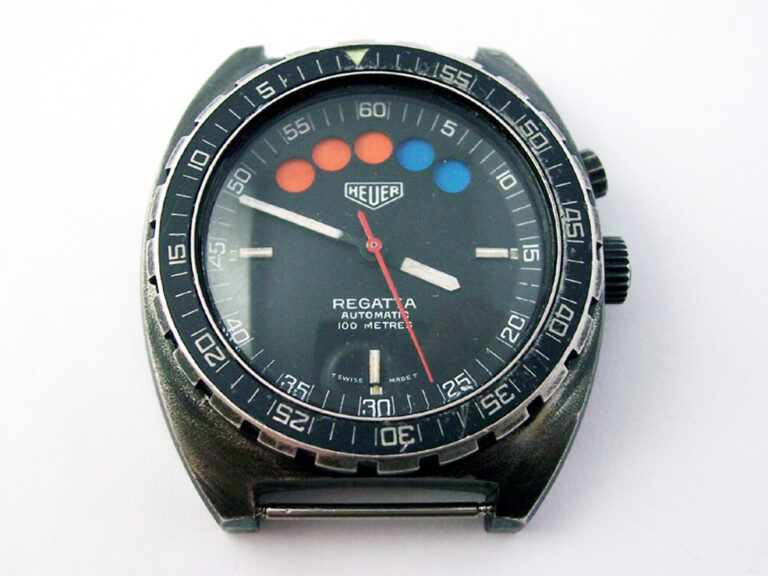
Aquastar Regate (Lemania Cal. 1345)…

A rarer version of the Regate this time, and one with a black rather than a silver dial.

(Click pictures to enlarge)

What makes this Aquastar different to the other Regate models on the blog is the design of the case and bracelet. It has what is called a ‘Lobster Tail’ or ‘Armadillo’ bracelet which consists of overlapping sections of metal, rather than being made up of independent links like a traditional bracelet.

While it sounds like more like an instrument of torture than a watch bracelet, it is surprisingly comfortable as the bracelet forms a natural band around the wrist.

The same case and bracelet was also used by Tissot who released a dual Tissot/Aquastar branded version of the Regate, and also a similarly styled chronograph fitted with a Lemania cal. 1341.

The calibre in the Regate is the Lemania cal. 1345 which is a modified version of the cal. 134x chronograph. Rather than repeating how the timer mechanism works, I’ll direct interested parties to this post for more details.

The watch arrived in running condition, but it hadn’t been serviced for many years. It was almost impossible to set the time or wind the watch manually, and the power reserve was minimal.

When disassembling the watch I noticed something odd about the dial. Underneath the “REGATE Automatic” lettering on the dial, it had once said “REGATTA Automatic”, the name of the Heuer variant of this watch. The deleted lettering was just legible using a microscope.

I presume that the dials for all models will have been produced in the same factory, but whether the Aquastar models were to be branded “REGATTA” rather than “REGATE” at some time, or they just had some Heuer dials left over and re-used them, who knows?

A movement service cured the winding and setting problems, so after a clean up, the watch was back to its best.

The owner of this watch, Mark Reichardt, has a keen interest in sailing timers. If you have any questions or information about them, especially the vintage mechanical models, I’m sure he’d like to hear from you. You can contact him at the following email address; j.m.reichardt@planet.nl

Rich.

** Many thanks to Mark for letting me feature his watch on the blog. **


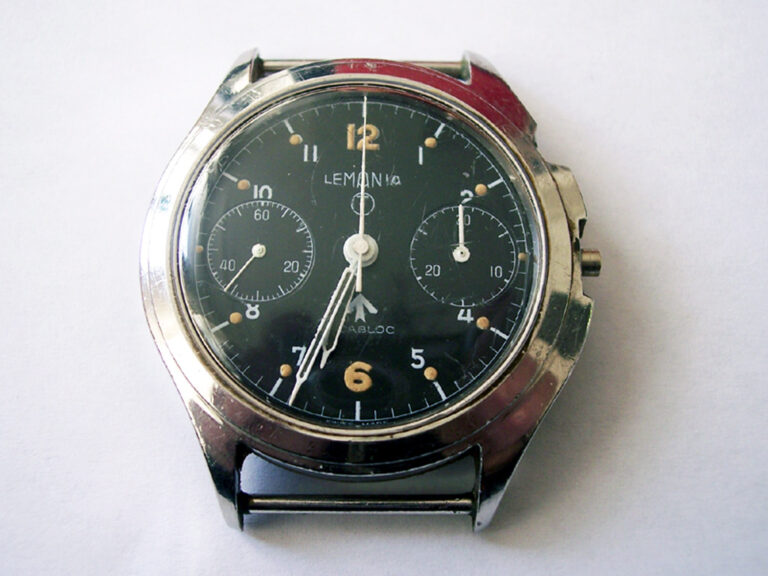
Herodia Chronograph (Lemania Cal. 1270)…

This Herodia chronograph dates to the late 50’s or early 60’s. While not a recognised brand, it was well worth restoring as it had significant sentimental value to its owner, whose father wore it every day for more than 20 years.

(Click pictures to enlarge)

A search on the internet uncovered very little about the company Herodia, though curiously the name is still being used by what looks to be a Spanish based sub-brand of the company Cyma (http://www.herodia.net/). There seems to be a few automatic models in the lineup but not using anything like the quality calibres of the past, which is a shame.

The movement inside this watch is the Lemania Cal. 1270, a good quality manually wound calibre from a well respected manufacturer. Though the watch was running, it wouldn’t do so for long and the chronograph functions didn’t work at all. Cosmetically, the condition was reasonable, the dial showed a little patina but on the whole not too bad. The case however, was another story.

Typical of many chronographs from this era, the case was made from thin 18 karat gold. As the lugs on these cases are hollow they are susceptible to damage and the watch had taken its fair share of knocks over the years. The case and bezel had a number of dents, and three out of the four lugs were damaged, the worst of which was punctured all the way through.

There was no way I could repair the damage myself, so it was time to enlist some professional help. I sent the case to goldsmith Sven Grollé, who did a great job, and after just a couple of weeks the case came back in near perfect condition.

With the movement stripped down, there were no major problems, a return spring was dislodged preventing the chronograph mechanism from working properly, and the short power reserve was caused by a ’set’ mainspring.

With a new mainspring ordered and fitted and the rest of the movement serviced, it was back up and running again. The movement was ready and waiting for the case to return, so it was just a matter of rebuilding the watch, and here’s the result.

Rich.

** Many thanks to Helge Johnsen for letting me feature his watch on the blog, and to Sven Grollé for the case repair. **


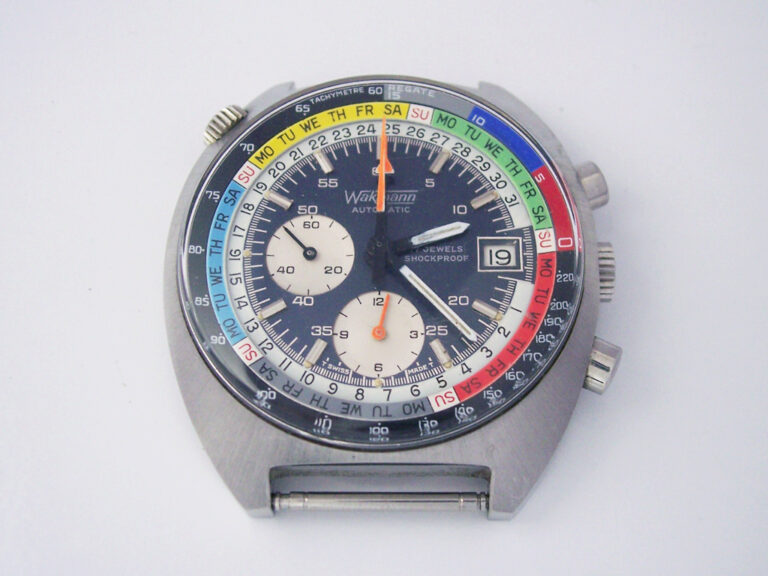
Nivada Autochron (Lemania Cal. 1341)…

Another great looking chronograph from Nivada, this time a Taravana Autochron.

(Click pictures to enlarge)

Bought while on vacation in Australia in 1973, this watch is still in the possession of its original owner. It was worn daily until the early 80’s when an accident while repairing a tractor left the glass broken and the wearer with a badly sprained wrist. (It must have been some impact as the crystal on this watch is 3mm thick).

Nivada are an under-rated brand in my opinion as they produced a variety of great looking chronographs over the years, all fitted with good quality calibres. Although the movements were often marked Nivada they never actually produced their own calibres, opting instead to re-brand ebauches from well known Swiss manufacturers such as ETA, Valjoux, and Lemania.

The calibre in this watch is a Lemania Cal. 1341 which I described recently in a post about a Tissot Navigator which has the same calibre. If you want to see a bit more ‘tech’ stuff, you can read that post here.

This Autochron has a rotating inner bezel which can be used as a timer, and is turned using the second crown on the left hand side of the case. Other models were also available in the same series, one with a fixed Tachymeter inner bezel…

… and also a model with a ’square’ case, reminiscent of the Heuer Silverstone chronograph from the same period.

The Autochron also bears more than a passing resemblance to the popular Sinn 142 which featured the same case and a reworked version of the Lemania cal. 1341, the Lemania cal. 5100.

With regard to the work required on this watch, needless to say that a new crystal would be needed, along with a service after it’s 25 year ‘retirement from active duty’. As a piece of the glass was floating around inside the watch, and I was concerned that it may have scratched the dial or hands, but luckily that wasn’t the case. So, with a new glass fitted and the movement serviced, the watch was back to its best.

Rich.

** Many thanks to John Graham for letting me feature his watch on the blog. **


Tissot Navigator (Lemania Cal. 1341)…

Another Tissot on the blog, and another chronograph, this time a Navigator from the 1970’s…

(Click pictures to enlarge)

During the late 1960’s and 70’s, Tissot had a range of chronograph models with the titles Seastar or Navigator (or both) featuring a variety of calibres, some hand wound (Lemania 873, Valjoux 7733/4) and some automatic (Lemania cal. 134x, cal. 5012).

The movement in this watch is a Lemania cal. 1341, an automatic, three register, cam lever chronograph. What makes this calibre interesting, both technically and visually, is that the minute register for the chronograph is not presented in a subdial, but as a separate minute hand that sweeps around the dial. The subdials in this calibre are an hour recorder at six, and running seconds at nine ‘o clock.

The cal. 1341 is a simplified version of the cal. 1340 which was first introduced in 1972. The main difference between the two is that the cal. 1341 has 17 rather than 22 jewels, and has no facility for adding a 24 hr function. The 1340/1 calibres are often linked with the Omega calibres 1040/1 and for good reason as they are almost the same, apart from a few technical improvements and an Omega rather than a Lemania branding.

In the 1930’s Tissot, Omega and Lemania formed a working group called La Societe Suisse pour l’industrie Horlogere (SSIH) which was the predecessor of Swatch Group of today. Therefore,  it is not a really surprising to see Lemania based calibres appearing in the watches of all three brands.

Removing the winding rotor from the movement reveals the heart of the cam lever mechanism…

Power for the mechanism is provided by the driving and coupling wheels, just like a traditional chronograph calibre. When starting and stopping the chronograph the position of the cam controls the raising and lowering of the coupling wheel onto the centre second wheel. When resetting, the coupling wheel is disengaged from the centre second wheel and the reset hammer moves across to return the centre second wheel back to the zero position. Also attached to the cam is the coupling yoke which provides the link to the hour and minute registers on the dial side of the movement.

Turning the movement over and removing the calendar plate and mechanism bridge, you can see that the rest of the chronograph functions…

In the picture above the mechanism is in”stopped” condition. You can see that the minute recorder clamps are in contact with the minute recording wheel holding it in position, and the hour recorder stop lever is arresting the hour recording wheel.

When the chronograph is started, the hour recorder stop lever pivots around it’s securing screw pulling back the valet which prises the minute recorder clamps open. The minute recording wheel then turns along with the cannon pinion on which it sits. The hour recording wheel is also released and turns along with the mainspring barrel.

As the watch was already in good cosmetic condition, it needed no more than a service to ensure it was as good inside as outside. Here it is all back together again.

Rich.