Wristwatch restoration, servicing and repair

Posts Tagged ‘Heuer’

Heuer Diver 844/3 (ETA Cal. 2872)…

This diver from Heuer is known as the 844/3, and was a popular model in the 1980s.

(Click pictures to enlarge)

Already an established name in the chronograph field, in the late 1970’s Heuer decided to test the water with a divers watch (pardon the pun!). Rather than set up an entire production facility they chose to rebrand an existing model from the French producer, Monnin. These early watches were fitted with an automatic Felsa movement and the only thing ‘Heuer’ about the watch was the dial, as the case and movement were still signed G. Monnin. For more information and pictures of the Heuer/Monnin diver, check out this post on Jarl Fr. Rehn-Erichsen’s blog Classic Heuers.

When the experiment proved to be a success, Heuer decided to develop its own version of the watch and switch production back to Switzerland. Rather than continuing with the Felsa movements, the watches were fitted with ETA calibres, and other models were added to the range; namely quartz and ladies versions of the watch. Here is a catalogue image from 1981 showing the models that were available.

Source: AutaviaPassion

In September 1985 TAG (Techniques d’Avant Garde) bought Heuer and from then on all watches were badged TAG Heuer. The 844 remained in the model lineup but was rebranded as the TAG Heuer 1000, a model that proved popular and remained in the range for many years. Even today the influence of the 1000 can still be seen in some of  the current Aquaracer models.

It’s hard to date the watch in this post exactly, but it must have been produced between 1981 and 1985 as it is fitted with an ETA Cal. 2872, and only has Heuer printed on the dial.

There wasn’t anything wrong with the watch this time, the movement just needed a service. As the original hands weren’t in the best condition, rather than restore them, the owner preferred to replace them with sword hands. The new hands weren’t an exact match and needed to be adjusted to fit properly, but the result was worth the effort I think.

You may have noticed that a Heuer transfer has been added to the rotor of this watch.  As the condition of the movement is much better than the rotor,  my guess is that the original rotor was damaged at some time and was replaced.

Rich.

** Thanks to Anders Bunes for letting me feature his watch on the blog, and to Marius Jensen for providing information and pictures for this post. **


Heuer Autavia 2446C (Valjoux Cal. 72)…

Arriving in a sorry state, this Heuer Autavia needed more work than most watches featured on the blog…

(Click pictures to enlarge)


The reason the watch was in such poor condition was due to a motorcycle accident in which the watch took a fair amount of punishment, one of the pushers had been ripped out and the impact had even caused the snap back of the watch case to pop off.

Needless to say, in the aftermath of such an accident, a watch doesn’t figure highly on the list of priorities, so it was ‘retired’ into a drawer where it remained for the next 36 years.

As well as the obvious damage, either during the crash or afterwards, moisture had found its way into the case and did what it does best, corroding the dial, hands and some of the movement parts. Consequently, the watch was no longer running and was stuck in the time setting position.

The calibre in this watch is the Valjoux 72; a 17 jewel column wheel chronograph calibre. The cal. 72 was one of the longest serving and most highly regarded members of the Valjoux lineup, and was used by many distinguished brands over the years. The calibre was based on the Valjoux 23, but with a 12 hour register added on the dial side. It was also available with a calendar complication, the cal. 72C.

At first glance, the movement didn’t seem to be in too bad a condition, with just signs of rust on some of the underlying components…

… but with the dial removed it was clear that the keyless works would need quite a bit of attention.

Luckily, the corrosion wasn’t as bad as it looked and all but one of the parts could be cleaned up and reused, so with the rest of the movement restored and running again it was time to tackle the cosmetic issues.

I was very lucky to find a near perfect replacement dial, and when the hands were cleaned and relumed, and the centre second hand rubbed down to bare metal and repainted, things were already starting to look better.

Although only one pusher was missing, on closer inspection the shaft of the remaining pusher had rusted too, so after the case had been cleaned, two new pushers and a new crystal were installed. The last thing to do was to fit a new strap and Heuer buckle to finish the job.

Here are the results…

Rich.

** Many thanks to Helge Johnsen for letting me feature his watch on the blog. **


Heuer Bundeswehr (Valjoux Cal. 230)…

This watch is known as the Heuer Bundeswehr chronograph, or “Heuer Bund” for short…

(Click pictures to enlarge)

The majority of these watches have the word “Bundeswehr” engraved on the back as they were issued to German servicemen from 1968 until the late 1970’s (Bundes Wehr means ‘Federal Defence’ in German). This watch however, is different and somewhat rarer, as it was issued to a member of the Norwegian Air Force.

The Bundeswehr watches were produced with a number of dial variations over the years (see here) and all featured high quality flyback chronograph calibres. The calibre in this particular watch is the Valjoux cal. 230; a hand wound 17 jewel calibre with a rate of 18,000 bph.

In a regular chronograph calibre the chronograph mechanism must be stopped before it can be reset. In a flyback chronograph, the mechanism can be reset while it is still running, making it particularly useful for timing consecutive short interval events. This is achieved by the addition of a additional lever in the chronograph mechanism. When the reset button is pressed the flyback lever lifts the coupling clutch from the chronograph centre wheel allowing the mechanism to reset.

As well as having a flyback function this calibre also hacks, which means that the movement stops when setting the time so it can be set to exactly to the right second.

With the chronograph mechanism and train wheel bridge removed you can see the hacking lever. When the stem is pulled out the setting wheel moves forward and the hacking lever pivots around the screw arresting the balance wheel (not present in the picture below). You can see in this picture that the main plate has been decorated with a perlage pattern underneath the balance wheel. The same decoration is also present on the dial side of the calibre, another sign of quality (see inset).

When the watch arrived, it was running but the chronograph mechanism was not working and further investigation revealed that the mechanism was stuck in the reset position. Thankfully, none of the parts were damaged, so after a service the movement was returned to fully working condition again and showed little sign of use.

With the movement up and running, the last thing to do was to relubricate the pushers and clean the case…

http://www.thewatchspot.co.uk/images/BlogImages/Large/Heuer-Bund-5.jpg

Rich.

** Many thanks to Jarl Fr. Erichsen of Classic Heuers for letting me feature his watch on the blog. **


Heuer Chronograph (Valjoux Cal. 71)…

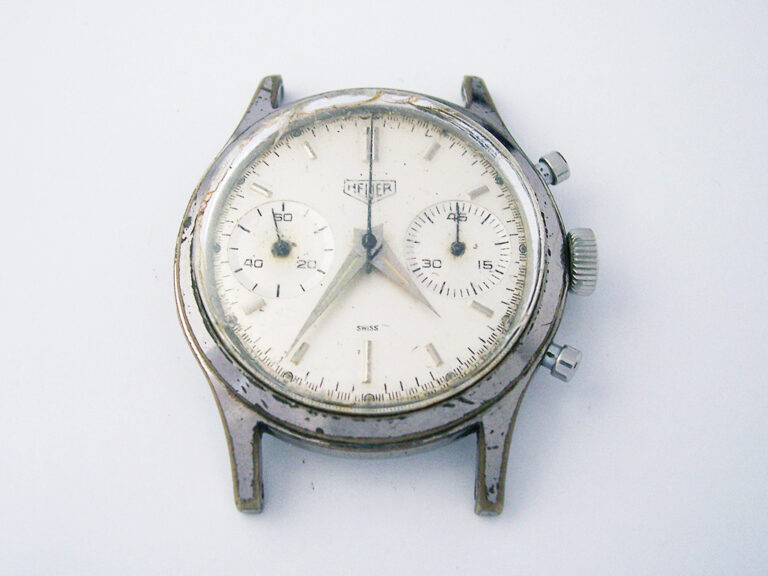
Another Heuer chronograph, this time a very handsome model from around 1940…

(Click pictures to enlarge)

The calibre in this watch is the Valjoux Cal. 71, a manually wound three register chronograph, capable of timing events up to 12 hours.

Although not obvious from the picture above, this calibre has a hairspring with a Breguet overcoil.  The difference between a regular (flat) hairspring and a Breguet overcoil is that the terminal curve is bent upwards above the plane of the rest of the spring…

The advantage of using a Breguet overcoil is that the centre of gravity of the hairspring remains constant regardless of position, and the spring can develop concentrically from the centre, promoting a more consistent rate. One disadvantage of using this kind of spring is that extra height is needed to accommodate the raised terminal curve. As extra height is needed for the chronograph mechanism anyway, space is not a problem with this calibre.

Apart from being in pretty scruffy state, the watch also had a couple of other issues. Firstly, the mainspring had ’set’. This condition usually occurs with older carbon steel mainsprings that have been coiled up in the mainspring barrel for too long. A modern alloy mainspring in good condition should have an ‘S’ form as pictured below, the old steel mainspring is pictured inset.

Secondly, the sliding gear spring was broken. This spring provides pressure on the sliding gear to ensure that the chronograph finger can advance the chronograph mechanism when engaged. Finding parts for older Valjoux calibres can be quite difficult these days, but thankfully it wasn’t too hard to find a replacement spring this time (inset).

With the movement cleaned and back up and running, it was just a matter of straightening the centre second hand and the job was finished…. not a bad looking 70 year old, I’m sure you’ll agree!

http://www.thewatchspot.co.uk/images/BlogImages/Large/Heuer-71-6.jpg

Rich.

** Many thanks to Jarl Fr. Erichsen of Classic Heuers for letting me feature his watch on the blog **


Heuer Autavia (Cal. 15)…

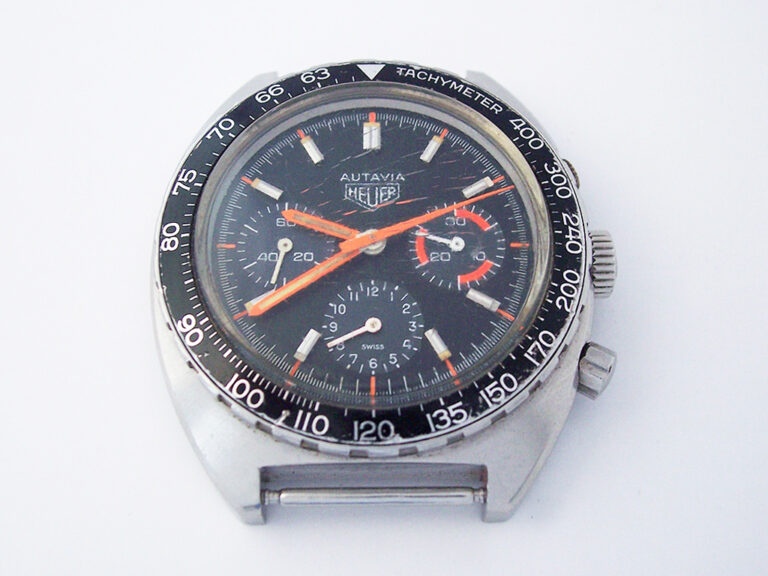
Here is a fine looking watch, a vintage Heuer Autavia from the early 1970’s…

(Click pictures to enlarge)

The Heuer name has a been around for a long time, the company being first started by Edouard Heuer in 1860. He developed and patented his first chronograph in 1882, and went on to patent the ‘oscillating pinion’ system in 1887, which has been used in chronographs for more than a century (this watch being no exception.)

In more recent times Jack Heuer (the great-grandson of Edouard Heuer) became the majority shareholder of the company in 1962, and two years later acquired their main competitor Leonidas Watch Co, to become Heuer-Leonidas SA.

A collaboration between the boffins at Heuer-Leonidas, Hamilton-Buren, Breitling, and Dubois Depraz brought to market the first ever automatic chronograph calibre, in March 1969. It was known as the Calibre 11 “Chrono-Matic” and was used in the Autavia, Monaco and Carrera models available at the time.

More automatic calibres quickly followed; first the Calibre 12 which was a redesigned Calibre 11 with a faster 21,600bph rate, then the Calibre 14 which added an additional GMT hand, and finally the calibre in this watch, the Calibre 15…

The Calibre 15 differs from the others in the series in that the design was simplified to include a running seconds indicator in place of a 12 hour register. If you compare the pictures above with an Autavia fitted with a Calibre 12, the differences are easy to see…

The basis for the Heuer calibres was the Buren Cal. 1281, onto which a Dubois Depraz chronograph module was added. The Buren calibre was never designed to accommodate such an addition so changes had to be made, one of them being a 180 degree rotation of the main plate, resulting in the crown being on the left and the chronograph pushers being on the right.

At first glance you would be forgiven for thinking that these calibres are manually wound, but with the chronograph module removed you can see that they have a “micro-rotor” winding mechanism hiding inside…

Originally developed by Buren, the main benefit of the micro-rotor system is that the winding mechanism is integrated into the main body of the calibre keeping the height to a minimum, making them ideal for dress watches. (For more information on Buren micro-rotors see here).

Ok that’s enough technical history, back to the watch! It arrived with a couple of issues; it would run, but not for long, and the chronograph didn’t work properly. A movement service solved the running problem as the oil sinks were all dry, but the chronograph was more of a challenge.

Once the chronograph had been re-assembled, it was obvious that the eccentric adjustment screws had been moved (ordinarily these screws aren’t moved during a routine service). If adjustment is needed it’s essential that you understand the function of each of these screws, as making an adjustment to solve one problem can easily introduce another elsewhere.

Progress was hindered further by small spots of corrosion on some of the parts, the most problematic being a spot on the fine teeth of the centre chronograph wheel. However, after careful removal of the corrosion and time spent on getting the adjustment right, it was running and resetting properly again.

The last thing to do was to replace the cracked crystal…

The owner of this watch, Jarl Fr. Erichsen, has a great collection of vintage Heuers, check them out on his blog Classic Heuers.

Rich.

** Many thanks to Jarl for letting me feature his watch on the blog **