Wristwatch restoration, servicing and repair

Posts Tagged ‘Aquastar’

Aquastar Regate (Lemania Cal. 1345)…

A rarer version of the Regate this time, and one with a black rather than a silver dial.

(Click pictures to enlarge)

What makes this Aquastar different to the other Regate models on the blog is the design of the case and bracelet. It has what is called a ‘Lobster Tail’ or ‘Armadillo’ bracelet which consists of overlapping sections of metal, rather than being made up of independent links like a traditional bracelet.

While it sounds like more like an instrument of torture than a watch bracelet, it is surprisingly comfortable as the bracelet forms a natural band around the wrist.

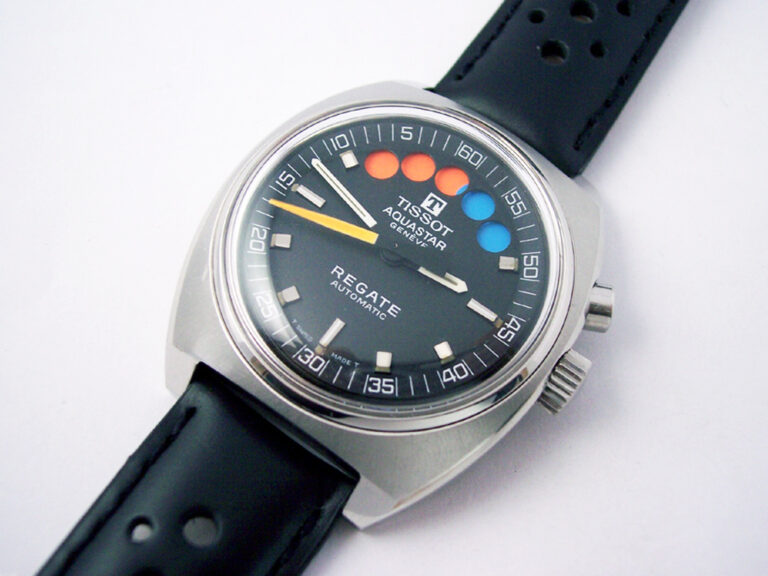
The same case and bracelet was also used by Tissot who released a dual Tissot/Aquastar branded version of the Regate, and also a similarly styled chronograph fitted with a Lemania cal. 1341.

The calibre in the Regate is the Lemania cal. 1345 which is a modified version of the cal. 134x chronograph. Rather than repeating how the timer mechanism works, I’ll direct interested parties to this post for more details.

The watch arrived in running condition, but it hadn’t been serviced for many years. It was almost impossible to set the time or wind the watch manually, and the power reserve was minimal.

When disassembling the watch I noticed something odd about the dial. Underneath the “REGATE Automatic” lettering on the dial, it had once said “REGATTA Automatic”, the name of the Heuer variant of this watch. The deleted lettering was just legible using a microscope.

I presume that the dials for all models will have been produced in the same factory, but whether the Aquastar models were to be branded “REGATTA” rather than “REGATE” at some time, or they just had some Heuer dials left over and re-used them, who knows?

A movement service cured the winding and setting problems, so after a clean up, the watch was back to its best.

The owner of this watch, Mark Reichardt, has a keen interest in sailing timers. If you have any questions or information about them, especially the vintage mechanical models, I’m sure he’d like to hear from you. You can contact him at the following email address; j.m.reichardt@planet.nl

Rich.

** Many thanks to Mark for letting me feature his watch on the blog. **


Aquastar Regate (Felsa Cal. 4000N)…

I recently had a chance to work on another Aquastar Regate, the first version from the 1960’s…

(Click pictures to enlarge)


I restored one of these a few months ago, and working on this one reminded me that I was going to write a post about how the sailing timer mechanism works. In previous posts I’ve described how the timer is supposed to be used (here if you missed it), and how the timer mechanism works in the later Lemania based model from the 1970’s (here).

To recap, the calibre inside this model is a Felsa cal. 4000N; a 18,000bph automatic calibre, modified to include the sailing timer. Like the Lemania based version, removing the dial and hands reveals the rotating disc for the timer…

The picture above shows the timer in “stopped” condition, in this state the disc is locked in position by the tension spring. When the pusher is pressed, the hammer moves under the disc contacting the pin on the underside of the disc pushing it around anti-clockwise 90 degrees until the red section is at the top and the 5 holes in the dial show red (inset).

Power for the mechanism is provided by the driving wheel which transfers power to the teeth on the disc, rotating it back to the stopped state in exactly 5 minutes. The tension spring ensures a smooth transition and locks the disc in place again when complete.

The driving wheel pictured above is mounted on the extended axle of the third wheel. Digging deeper into the going train you can see that the third wheel is actually two independent wheels on a single axle with a friction washer separating them (inset below)…

While the lower of the two wheels performs the normal function of a third wheel in the train, the upper wheel is responsible for providing both the power to the timer driving wheel, and to the centre second pinion. In normal operation both wheels rotate together due to the friction provided by washer between them, but when the pusher for the timer is pressed, the friction provided by the washer is overcome and the upper wheel rotates independently, also moving the second hand back to zero to start the countdown.

With the wheel train bridge removed you can see how the third wheel is connected to the centre second pinion…

This calibre has one more technical trick up its sleeve. When the timer is engaged it is essential that the second hand is returned precisely to zero to start the countdown, regardless of its position. This is made possible by the addition of a cam to the centre second axle, and beside it you can see there is a spring loaded lever. When the wheel train bridge is in place, this lever is pressed against the cam and stops the second hand in the zero position when the notch on the cam hits the lever. To give an idea of scale here, inset is a picture of the lever spring next to the head of a standard match.

As the only problem with this watch was a lack of servicing, so after a clean and oil it was back up and running again. The only thing left to do was straighten the second hand, and polish the cloudy crystal. Here’s the result…

Rich.

** Many thanks to Jamie Butterworth for letting me feature his watch on the blog. **


Aquastar Benthos 500…

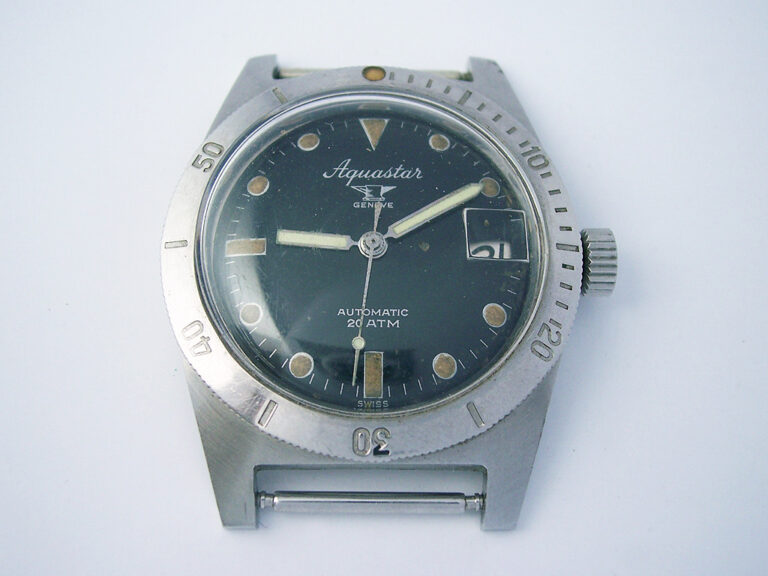
Another model from Aquastar, this time one of their divers watches, the Benthos 500…

(Click pictures to enlarge)

Produced between 1962 and 1972, this was Aquastar’s first diving watch, the model name “Benthos” coming from Greek for ‘the bottom of the sea’ and “500″ being the depth in meters to which the watch is water resistant. When first released, the Benthos was the first diving watch to use round as opposed to flat gaskets which significantly improved water resistance.

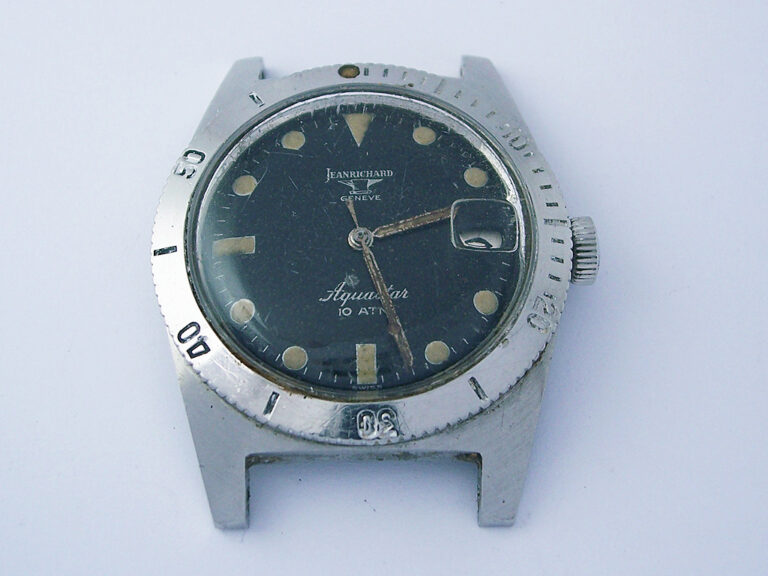
There were several changes made to the Benthos throughout its production run, compare the following watch with mine and you’ll spot some subtle differences…

The case is wider, it has a different crown, the bezel insert is different (possibly made from a different material?) and there are a couple of small differences on the dial; no “SA” under the Aquastar Geneve logo and the ‘Swiss Made’ label is under the 6 marker, not between the markers.

The watch was made with two different calibres, both from A. Schild, the cal. AS1902 and the cal. AS2162. Both are 17 jewel automatic calibres, the main difference being the rate at which they run; the AS1902 at 21,600bph and the AS2162 at 28,800bph. (The one in my watch is a AS2162.)

Both calibres were modified to include a minute timer, you may have noticed the extra hand in the first picture. The timer is started using the pusher, which when pressed returns the minute counter hand back to the 12 o’ clock position. It then moves in sync with the minute hand to time a maximum of 60 minutes.

My watch arrived with more problems than I was expecting, though it was running, the minute timer didn’t work or reset properly and the dial and hands were in much worse condition than I thought…

A faulty minute timer seems to be a common problem with these watches, and when you see how it works, it’s not hard to understand why.

Here is a picture of the movement with the dial removed so you can see the minute counter mechanism….

The first thing to notice is that the whole movement is cased in a solid steel ring, the pusher lever is mounted on this ring and contacts the rack mounted on the movement.

When the pusher is pressed the rack turns and rotates the minute counter wheel back to zero. For the next 60 minutes the minute counter wheel and cannon pinion (on which the minute hand is mounted) rotate together until the mechanism is returned back to the state above.

The minute counter wheel sits between the hour wheel (removed in the picture above) and the cannon pinion with a friction washer between the two.

The friction washer performs two functions, firstly when the pusher is pressed it allows the minute counter wheel to slide over cannon pinion until the hand is back at zero and secondly, it provides the tension required to bind the minute counter wheel and cannon pinion making them turn together while the timer is running.

As you can imagine after almost 40 years of use, there is a good chance that the brass minute counter wheel has worn or the brass friction washer has lost some of it’s essential tension, causing the minute counter to slip and lose time. My watch had exactly that problem, but after spending some time on it, I managed to get it working again.

With the movement serviced and the timer fixed, it was on to the cosmetic issues. After removing the old lume from the dial and repainting the markers, I relumed the hands, repainted the minute counter and second hands and finally cleaned the case…

Rich.


Aquastar Regate (Lemania Cal. 1345)…

Having recently restored one of Aquastar’s first Regate models, when the chance came along to pick up a later version, I took it…

(Click pictures to enlarge)

The watch arrived in pretty much the same condition as the last one, cosmetically reasonable, but it would only tick for a few seconds and the sailing timer function didn’t work.

This model was first introduced during the 1970’s and added an extra function to the original version; timing for both periods of the countdown, showing blue dots for the first five minutes and red dots for the second. (I explained how to use a sailing timer in the previous Regate post, click here if you missed it).

The movement inside this one is a Lemania cal. 1345. It is based on the cal. 1341 cam lever chronograph used in some of the Omega and Tissot chronographs from the same period, but with a sailing timer in place of the chronograph mechanism. It has a uni-directional automatic winding mechanism and it ticks at a rate of 28,800bph.

The most interesting part is obviously the sailing timer, here’s a description of how it works…

Removing the dial reveals the countdown disc with the two coloured sections for the timer…

Underneath this is the timer mechanism where the chronograph parts would be in a cal. 1341…

(Click picture to enlarge)

The picture on the left shows the timer mechanism in “stopped” state. (I can’t find the official names for these parts so I’m going to have to ‘wing it’, hopefully it will be understandable!) The rack sits at its upper limit, pressed against the stopper by the spring underneath. The rack also holds the timer wheel steady and away from the power source. If you look closely you can see that the timer wheel is disconnected from the intermediate wheel at this point. In this state, the holes in the dial show all silver.

The picture on the right shows the mechanism in “started” state, i.e. after the pusher has been pressed. The rack turns until it hits the stopper, turning with it the timer wheel on which the countdown disc sits. The timer wheel now engages with the intermediate wheel. In this state, the holes in the dial are now all blue.

With the rack removed you can see the power source for the mechanism, a driving wheel attached to the elongated third wheel axle. Two intermediate wheels transfer the power from the driving wheel through to the timer wheel…

All three of these wheels turn constantly if the watch is running, so when the pusher is pressed, the second intermediate wheel has to be disengaged from the timer wheel to allow it to rotate freely. To achieve this, the two intermediate wheels are mounted on a spring loaded rocker. When the pusher is pressed, the disconnecting lever moves the second intermediate wheel away from the timer wheel and the rack turns it to the “started” position.

On releasing the pusher, the second intermediate wheel springs back into contact with the timer wheel and the timer is now running. For the next ten minutes the power provided by the driving wheel turns the timer wheel back to the “stopped” position, rotating with it the countdown disc under the dial.

On the other side of the calibre, with the winding rotor removed you can see the reset mechanism…

When the pusher is pressed, the operating lever performs two functions. Firstly, it pushes the cam which lifts the coupling wheel from the centre wheel, and also pulls the connecting rod to turn the rack on the opposite side of the movement. Secondly, once the coupling wheel is disengaged from the centre wheel, the second hammer moves across resetting the second hand back to zero to the start the countdown.

I took a bit of gamble on this watch as parts would have been hard to track down, but thankfully, nothing was missing or broken. The timer mechanism had just been assembled incorrectly, so once I figured out how it worked and set it up correctly, it worked perfectly.

With the timer problem solved and the movement cleaned and oiled, I relumed the hands, repainted the faded second hand and fitted a new crystal. Here’s the result…. all I need now is a yacht!

Rich.


Aquastar Regate (Felsa Cal. 4000N)…

Here’s something different, a sailing timer from the Swiss company Aquastar…

(Click pictures to enlarge)

From the early 1960’s onwards, Aquastar were one of the few companies who featured a sailing timer in their line-up, the purpose of which was to give the wearer a visual countdown to the start of a yacht race.

So how does it work? Well as you’d imagine, arranging a standing start for a yacht race can be a bit tricky(!), so two starting pistols are fired; the first 10 minutes before the start, and the second 5 minutes before the start. It’s then up to the crew to ensure that their yacht crosses the start line as close to the start time as possible, but not before.

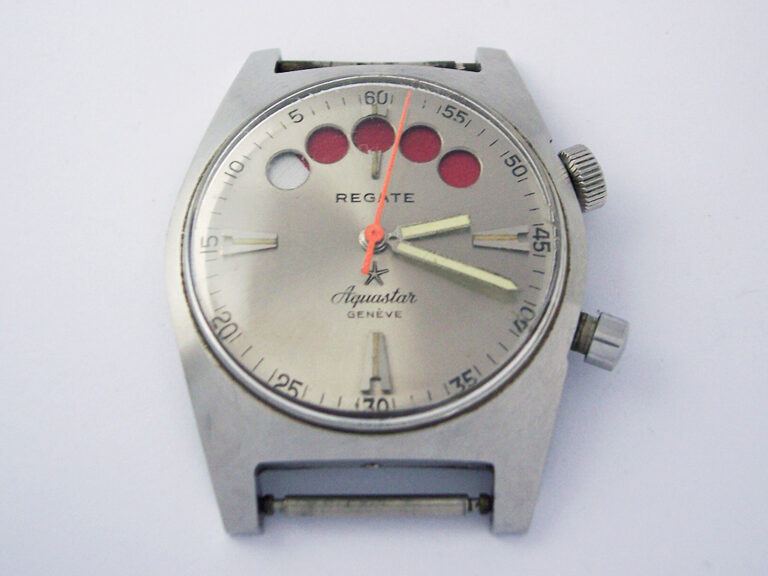
When wearing the Aquastar timer, on hearing the second pistol you push the reset button, the centre second hand returns to zero and the five ‘minute markers’ on the dial turn red. As the last five minutes of the countdown elapse the minute markers turn slowly back to silver and when all the markers are silver the race is underway. The system works well, as even at a glance you can see how much time is remaining.

Being Aquastar’s first sailing timer the Regate only tracked the last part of the countdown, but in later models the function was enhanced to cover both parts of the countdown, with blue markers for the first five minutes and red for the second.

During the 1960’s Aquastar watches were distributed by Heuer, and in 1965 they went into partnership to develop sailing timers, the Heuer name being added to the dial of subsequent Regates…

(Picture and Heuer information from OnTheDash)

… and in the 1970’s, Heuer went on to develop its own range of sailing timers and continued to offer a mechanical timers in its line-up until the mid 1980’s. Here is a picture from a 1980’s Heuer brochure…

Ok, back to my watch… Although being in decent cosmetic condition, it arrived with several problems; it would only run for a few seconds, the timer didn’t work and the reset button didn’t do anything.

The movement in this watch is a Felsa 4000N, an 18,000bph calibre with both automatic and hand winding. At first glance, it would seem that the timer function is simply a module added to the base calibre. However, further investigation reveals that the changes go much deeper, including a third wheel with an independent shaft allowing for the second hand to be reset. (I hope to cover how the whole timer mechanism works in a subsequent post.) —-> That post has now been written, see here.

It looked as though someone had tried to fix this watch in the past but given up, the timer mechanism had been assembled incorrectly and judging by the condition of the oil it must have been many years ago. Thankfully all the parts were there, so after a thorough clean and some ‘head scratching’ during assembly it was finally back up and running again.

With the mechanical problems solved, a clean up for the case and a new crystal finished the job (It’s a shame that the dial has a few age spots in the lacquer, but on the whole it’s not bad at all)…

If you would like to read more about the Aquastar brand and its history, check out their website here.

Rich.