Wristwatch restoration, servicing and repair

Archive for the ‘World Time/GMT Watches’ Category

Glycine Airman 2000 (ETA Cal. 2893-2)…

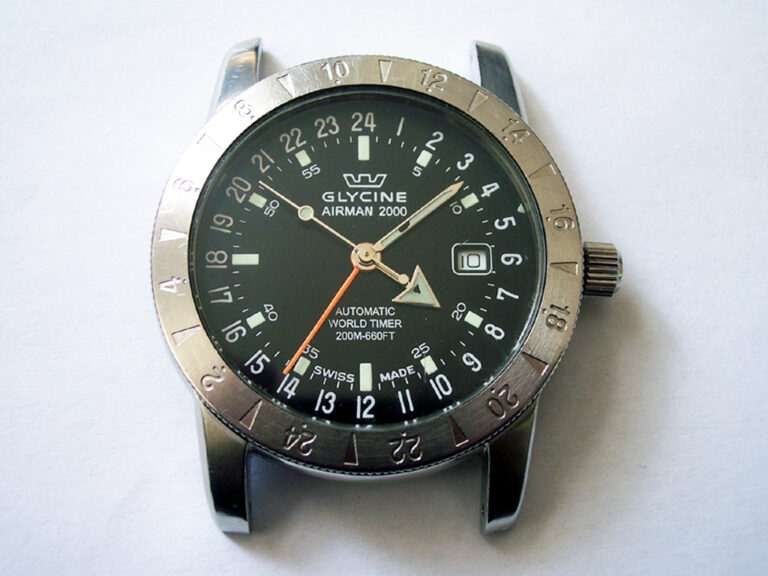
It’s been a while since I’ve written about a World Time/GMT watch on the blog, so here is one from Glycine, an Airman 2000.

(Click pictures to enlarge)

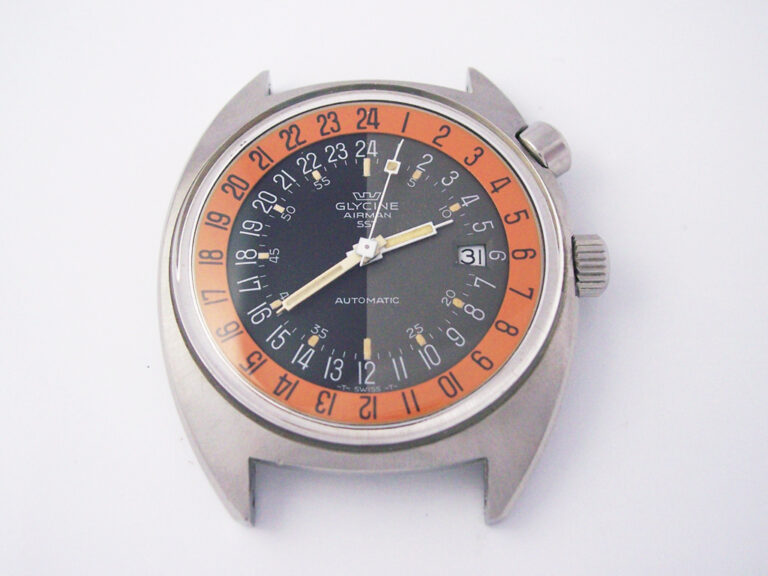
The Airman is without doubt the most widely recognised model that Glycine have ever produced. It was first introduced in 1953, and has been part of their line-up ever since. Aimed at pilots and travellers, the Airman had a 24 hr dial (the hour hand only makes one trip around the dial per day rather than two) and a rotating bezel which allowed the wearer to track the time in a second time zone.

The original Airman was produced from 1953 to 1978 and needless to say, the early models are now highly collectible. The earliest versions were fitted with a Felsa cal. 692N and at some time during the 1960’s the calibre was switched to a A.Schild cal. 1700/1701.

The watch in this post, the Airman 2000, was introduced in 1998 and differs from the traditional Airman style in that rather than having a 24hr movement like the original Airman, this model is fitted with an ETA cal. 2983-2 which has a traditional hand arrangement; the hour hand circles the dial twice per day.

An orange ‘24hr’ hand has been added which rotates just once per day allowing the second time zone to be tracked, (this hand can be moved independently of the hour/minute hands via the crown and so can be set to any hour of the wearers choosing), and just like the original Airman, the bezel also rotates so it can be used to track a third time zone.

As you can see in the first picture, the watch had seen better days; the paint from the numbers on the bezel had been scratched out and some of the lume from the hands was missing. According to the owner, it had probably never been serviced, so it was more than ready for a complete overhaul.

The first thing to do was to repaint the numbers on the bezel and when dry, coat them with a thin layer of clear lacquer.

After the movement had been serviced, attention was given to the missing lume from the hands. Rather than trying to fill in the holes, it is much better to remove all the existing lume from the hands and relume them. That way there is no chance of a ‘patchy’ look on the final finish and an uneven glow when charged.

Here is the watch all back together again.

Rich.

** Many thanks to Marc Vos for letting me feature his watch on the blog. **


Seiko 6117-6019 (World Time)…

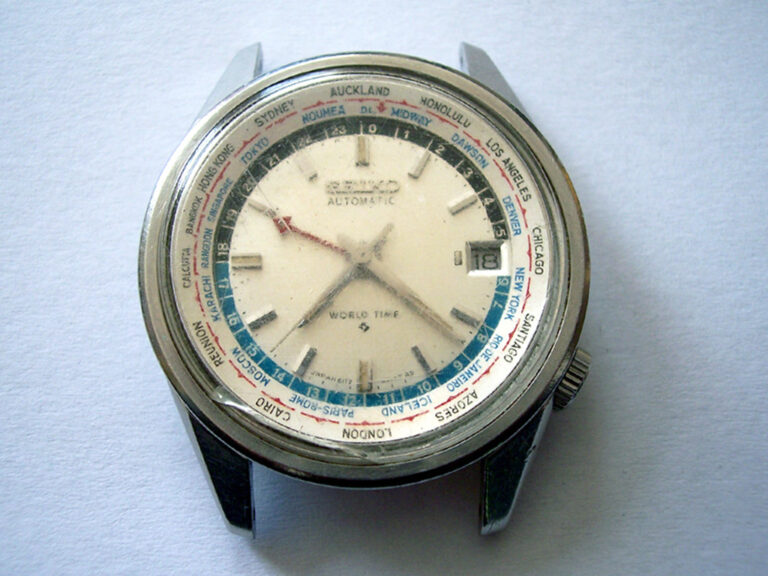
Having tackled a number of Seiko’s World Time models in the past, I had the opportunity to work on this one, a second generation model from 1968…

At first glance you could be forgiven for mistaking this watch as a first generation model but there are a number of differences; it doesn’t have the large fluted crown of the first generation model, the GMT hand is red and the hands and dial indices are lumed (see a first generation World Time here).

The most significant difference though is inside as the watch is fitted with a cal. 6117A rather than the cal. 6217A used in the earlier World Time watches. The cal. 6117A is almost the same as the cal. 6117B found in the third generation models, the only difference seems to be that the 6117A doesn’t hack.

It’s always a bit of a lottery buying a watch with a badly scratched crystal as you can never be sure what is hiding underneath and unfortunately this time, removing the crystal revealed a few scratches on the dial caused by clumsy handling in the past…

Another problem with the watch was that the wrong crystal had been fitted, trapping the city bezel. This meant that when the crown was turned to rotate the city bezel it damaged the delicate plastic teeth on the city bezel ring.

Both of these things were pretty bad news as finding suitable spare parts for this model without locating a second watch can be very tricky these days.

While I couldn’t repair the dial I had nothing to lose in trying to file out the damaged teeth on the city bezel and rebuild them. While the resulting teeth aren’t perfect, they were certainly good enough and the bezel worked perfectly again.

With the current dial it isn’t quite back to its best, but with a new crystal it’s certainly wearable again…

Rich.

PS. Many thanks to Ralf (watchbear71) for giving me the chance to take a closer look at this one.


Seiko 6117-6410 (World Time)…

This World Time is one of the third generation models, fitted with the same calibre as the Navigator Timer I restored a few months ago, the 6117B…

(Click pictures to enlarge)

Although not running, this one was in decent cosmetic condition, but had been fitted with the wrong crown and stem, meaning the city bezel wouldn’t rotate. Further investigation revealed that the hairspring was damaged and it was also missing it’s casing spring.

The stem and crown for this watch is the same as the very popular 6139-600x series of chronographs and some of the 61xx ‘Sports’ models (all of which have a rotating inner bezel), so I was hopeful that I might find just the parts I needed, but alas, no luck. I ended up buying another project watch, which isn’t a bad thing, as it’s always good to have a few spares on hand for future projects.

The donor watch provided all parts I needed with the exception of the hairspring which was in even worse condition than the first one, so after the rest of the service was done, it was out with the fine tweezers (and an extra helping of patience!) to reshape the original.

To freshen up the cosmetics I cleaned up the lume on the dial and relumed the hands. I also refinished the case a little and polished up the original crystal, which only had a few minor scratches…

One last thing to point out on this watch is that Seiko made a mistake when printing the city bezel text. On the early examples, London was printed in the same timezone as Paris/Rome…

…which never happens, even taking BST (British Summer Time) changes into consideration. Seiko must have realised, or been informed of their mistake, as on the city bezels printed for the later models, the error was corrected…

Picture by Ralf / watchbear-71

Rich.


Seiko 6217-7000 (World Time)…

I don’t mind a bit of a punt from time to time, so I took a bit of a gamble on a World Time model with decidedly average photos. But when it arrived, I was glad I did! Although missing its crown and stem, it was running, and in decent cosmetic condition…

(Click pictures to enlarge)

This watch was first introduced in 1964, along with the 571x series of chronographs, to commemorate the Tokyo Olympics. They were differentiated from the regular models by an Olympic flame motif on the caseback…

(Picture from Jayhawks Watch Photograph Database)

However, back in the early sixties Seiko were embossing rather than stamping their casebacks, which meant that if worn extensively, the embossed part of the caseback would wear away, eventually disappearing completely to leave only the stamped serial number. Consequently, watches with embossed casebacks in good condition are highly prized by Seiko collectors these days.

This is the second 6217 World Time I’ve restored, and as I’d sourced a donor watch to fix up the first one I already had a spare crown and stem, including the all important winding gear for the city bezel, to use on this one.

So with all the parts to hand, a movement service, a clean and polish for the case and a new crystal was all that was needed this time…

The caseback on this watch, though not in great condition, is still visible at least!

Rich.


Seiko 6117-6410 (Navigator Timer)…

Arriving in good cosmetic condition, and with all it’s original lume intact, this Navigator Timer had potential right from the start. Although, it was missing it’s bezel…

(Click pictures to enlarge)

The calibre in this watch is the 6117B which was introduced in 1968, and is basically a 6105 calibre with an added GMT function. As well as being used in all of Seiko’s Navigator Timer models, it was also used in the second generation World Time watches, replacing the 6217A movement found in the first generation models.

On removing the dial I was expecting to see a fixed pinion attached to the minute wheel, just like the 6217A, but no, on this calibre the extra pinion is placed on top of the intermediate date wheel. This means that the 24hr wheel is now in sync with the date mechanism, which probably makes more sense, as they both need to rotate once per day.

After tracking down a replacement bezel, I was ready to get started, and with no major problems to fix, a movement service, a polish for the crystal and some refinishing on the case quickly got this one back up to spec…

If you are unaware how this watch works, the internal bezel can be used to track the time in a second time zone. The red (GMT) hand rotates once around the dial in 24 hours and the internal bezel, which is marked in hourly increments, can be rotated using the crown.

Let’s say that I’m currently in London and I want to keep track of the time in Los Angeles, which is eight hours behind. To do this I simply rotate the inner bezel 8 markers anti-clockwise so that ‘16′ marker on the inner bezel is opposite the 12 hour marker on the dial. The GMT hand now always points to the current time in Los Angeles. So, you can see in the following example that as it’s almost 4pm in London, it’s nearing 8am in Los Angeles….

It’s also easy to tell at a glance whether it is day or night in the second time zone, as the red portion of the bezel signifies daylight hours, and the blue portion night time hours.

Rich.